







In 2026, marketing goals would plummet to the ground without automation. Whether you’re a business owner or a professional marketer, automation software is a business staple. With them, finding new leads is easier, forging connections is simpler, and timing both actions for precision is possible. Naturally, marketing teams across the world are resorting to tools that ease their burden of performing routine tasks. It empowers them to focus on running creative campaigns on multiple channels while their less interesting, tedious to-do lists get checked off by AI.
What is Marketing Automation and Why It Matters in 2026?
For someone inexperienced, the term “marketing automation” might feel intimidating. Fret not, because in practice it's quite simple. Marketing automation refers to the use of one or more software tools/platforms/applications to automate marketing activities. In essence, it means letting automated software execute the boring, repetitive marketing activities that your team can trade in favor of creative expansion. Tasks like sending emails, posting on multiple social accounts, and sharing targeted messages can be automated to improve the operational efficiency of your organization.
As the global market grows more competitive, the marketing automation sector is projected to grow to a whopping USD 81 billion by 2030. Predictive analytics and personalized customer experiences are helping businesses scale faster. In parallel, research is underway and innovation in this sector is being funded heavily. Marketing teams that leverage marketing automation tools are able to keep ahead of the curve, while those that don’t adapt fall behind quickly. As you aim to start or grow your business, it’s imperative to integrate these tools into your marketing strategy for maximum impact.
Features to Look For in Marketing Automation Tools

Keeping your eyes peeled for the most state-of-the-art automation software is impressive. At the same time, certain key features make automation tools a complete package deal. Here are the best ones that you should look for when choosing the right tool:
- Integration And CRM
Marketing automation integration refers to the streamlined connection of marketing platforms with other applications like CRM and e-commerce platforms. A tool that allows you to integrate all available user information by syncing data from across apps is an efficient automation partner. Not only will the organized user journey let you track customer experiences, but also facilitate planning workflows and campaigns.
- Lead Management
An effective marketing automation tool should allow easy capture of leads and collection of data through their activity across the web and social platforms. This information can be utilized further to analyze and share information with them that piques and nurtures their interest in your business. Lead management through automation of marketing steps can help secure conversions faster and resolve inconsistencies to avoid potential losses.
- Multi-Channel Tools
Powerful tools are designed to function across several web and social channels to provide you with a unified view of customer journeys. They make campaign management, cross-posting, and email marketing smoother. Moreover, the collection and processing of volumes of customer data is made easier as well.
- Personalization Features
Several marketing automation tools categorize and segment customers to target them more acutely. With a personalization feature, your team will be able to reach customers at the right time on the right platform with the right message. Your marketing objectives are achieved more swiftly when automated tools solidify connections in a timely manner.
- Analytics And Reports
When your automation tool is designed for efficiency, it’ll give you access to abundant data. Analytics help marketing teams determine what is working well, what needs changing, and to what extent. The tool can provide you with data about which leads or customers are proactive across channels and which of them are not. Numbers and insights can reveal the impact of your campaigns and help you plan future strategies.
For example, Boltic provides actionable insights to business owners for enhanced decision-making. It has robust pipelines that extract and process volumes of data to offer accurate insights into customer behaviour.
Marketing Automation Compared with Manual Marketing Workflows
A simple comparison between marketing automation and manual workflows demonstrates the difference automating tasks can make.
Top Marketing Automation Tools for Businesses & Marketers in 2026
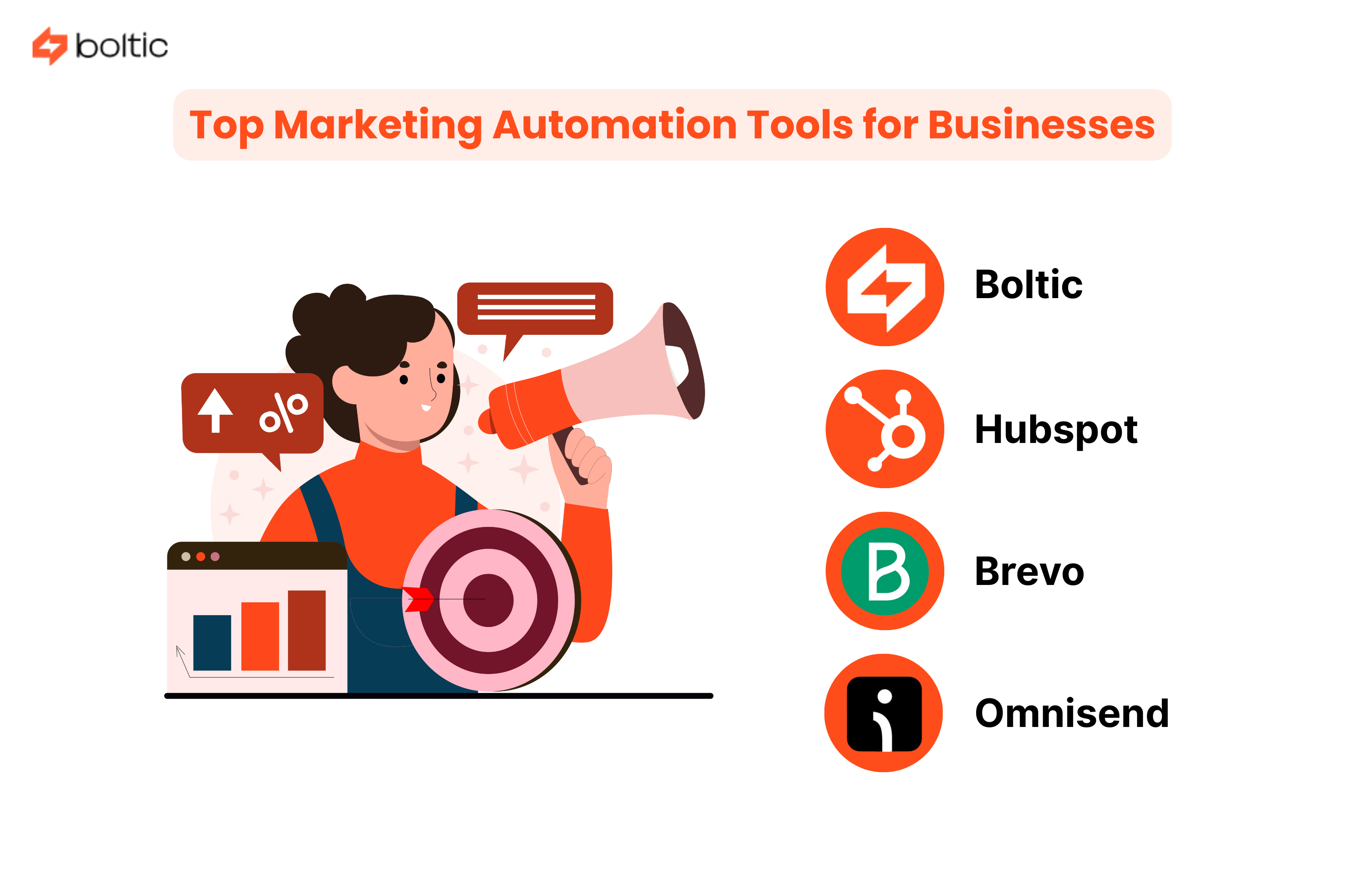
Let’s take a look at the best marketing automation tools in 2026 that have earned the favor of businesses:
1. Boltic
A no-code AI-powered automation platform designed to streamline marketing workflows, Boltic is a one-stop platform for everything. It brings the best of automation and endless features to prime your business for success.
Pluses
- No-code automation for ease of use
- Simple workflow builders and AI agents
- Real-time data tracking and pipeline management
- Multi-channel automation features
- Enhanced performance tracking and scalability
Minuses
- General automation risks
- Has a learning curve when the complexity of tasks increases
2. HubSpot
A complete inbound marketing package deal with additional perks like CRM integration and automation, HubSpot is a hit among marketers. It has a powerful lead management system and allows for endless content automation.
Pluses
- Ideal fit for small to medium-sized businesses
- Seamlessly integrates a variety of automation requirements like lead management, CRM, and content management.
Minuses
- Extremely expensive for startups or small businesses
- Limited features are available for free
- Omnichannel automation doesn’t cover complete automation needs
3. Brevo
Formerly known as Sendinblue, Brevo is simple and yet highly efficient. It comes with a multitude of free features and makes workflow automation easy for startups and small players.
Pluses
- Easy and simple automation
- Free multi-channel automation features
- Enables the use of simple CRM features and a meeting scheduler
- It is budget-friendly for startups and small businesses
Minuses
- Lacks dedicated CRM features
- It is not flexible enough
- Important features are paywalled
4. Omnisend
Designed for e-commerce businesses, Omnisend is another name that impresses marketers and business owners. You can see it as an upgrade on Brevo, except exclusive to e-commerce sites.
Pluses
- Extensive pre-designed automation features
- Provides omnichannel workflows
- Free plan with premium features
Minuses
- Exclusively focuses on e-commerce
Benefits of Marketing Workflow Automation
Automating your marketing workflow through tools and software opens up a door full of opportunities for your business. It acts as a reliable partner for optimising marketing decisions and expanding your activities. Below are the broad benefits that you’re set to gain from automating your marketing process:
- Ease Of Management
Marketing automation tools enable users to track activities and engagements of prospects across channels. It extracts, collects, and compiles the data to provide business owners with a unified view of their scale of impact. Not only does this facilitate targeting the right potential customers, but marketing teams can utilize this data to their benefit. Campaign planning can centre on customer segments in a planned manner for the highest conversions. Personalized strategies can be applied to drive leads to the next step, too.
- Tracking Customer Journey
Effective automation tools gather and process volumes of data from across applications, e-commerce platforms, and CRM tools. This allows you to track the journey one or more customers or their specific segments undergo with your business. Integrated systems help you remain in touch with the preferences and behaviour of your customers. Such insights can act as valuable memos when planning a sales pitch or guiding customer behavior.
- Precise Decision-Making
Marketing automation tools are designed to turn raw data into information for strategic use. Wide-scale data analytics and reporting can aid you in determining which strategy shines and which fails. Tweaking your marketing objectives for the highest business outcomes becomes less time-consuming and more definitive.
Powering AI Workflow Automation with Boltic
An AI-powered workflow automation and data analytics platform, Boltic is dedicated to eliminating slow, unsystematic execution in marketing processes. It enables businesses to customize workflows based on their marketing requirements. A comprehensive, robust pipeline works swiftly to convert raw data into valuable insights to promote targeted lead management.
Boltic offers a multitude of workflow automation features like visual builders, a huge database, pre-designed templates, and CRM integration. With this marketing automation partner, you’ll need to look no further.
Conclusion
A common misconception with marketing automation tools is that they will replace human marketers. It is essential to understand that collaboration is the goal, not displacement. With increased human-AI partnership, the scope of marketing shall transform in the upcoming decade. Human marketers can focus on creative strategies and innovative decision-making while marketing automation takes over mundane campaign to-do lists. The aim is to alter the longstanding task list for marketers by allocating the marketing chores to automation, not to drop them altogether.
drives valuable insights
Organize your big data operations with a free forever plan
An agentic platform revolutionizing workflow management and automation through AI-driven solutions. It enables seamless tool integration, real-time decision-making, and enhanced productivity
Here’s what we do in the meeting:
- Experience Fynd Boltic's features firsthand.
- Learn how to automate your data workflows.
- Get answers to your specific questions.

.webp)
