

Customer support AI workflow automation is the use of intelligent systems to analyse customer input, anticipate intent and perform predetermined actions without human intervention. Some of these actions are categorising a ticket, drafting a reply, forwarding a problem to the appropriate agent or performing routine tasks such as searching in the knowledge base to find an article. Unstructured data (emails, chat messages, voice transcripts, etc) can be fed to AI tools to extract structured information, which can then be used to drive automated processes.
Automation of the workflow of AI is aimed ultimately at reducing the time of resolution. It is a common consequence of customers waiting, as support teams become mired in manual processes such as reading a message, tagging a ticket, or redirecting queries to the correct department. AI eliminates these processes and provides a seamless integrated channel between the intake and resolution. Support teams can work in an integrated and intelligent structure rather than fragmented mechanisms.
What is AI workflow automation in customer service?

AI workflow automation in customer service is the use of artificial intelligence to automate repetitive and foreseeable operations in customer support. It uses a combination of natural language processing, machine learning, predictive analytics, and automated decision-making to implement workflows traditionally handled by people.
AI does not just substitute work. It optimises them using patterns of thousands of tickets. As an example, it can be taught how agents categorise enquiries, how they answer frequent questions and how they deal with escalations. After training, the system goes on to automate requests according to these patterns in an accurate and rapid manner. This minimises the cases of inconsistency, and each customer is served in real time.
The majority of the customer service processes are predictable. AI determines these patterns and maximises them. It can be an e-commerce return request, a billing query, or a technical troubleshooting request, but in any case, an AI is able to automatically guess the proper workflow and start it. This leads to fewer bottlenecks, improved prioritisation, as well as smoother flow of customers and support agents.
How AI transforms the end-to-end support lifecycle?
All interactions between customers and services go through a lifecycle. AI changes every step and makes it one, and a very productive experience.
- Automated ticket intake and classification: AI applications are able to scan emails, instant messaging, and web forms to interpret the purpose of a request. They label the ticket, classify the problem, define the sentiment and derive vital data. This will minimise the process of manual classification, one of the most time-consuming customer support processes.
- Intelligent routing: After a ticket has been classified, the artificial intelligence suggests the most appropriate agent, team, or workflow to respond to the problem. The routing is done on the basis of expertise, history of performance, language, workload or priority. This will make sure that the right individual is in charge of the request.
- AI-assisted responses: AI is capable of writing reply proposals based on historical data, knowledge base data, and past responses of the agents. Agents need to revise and customise the message, and this saves a lot of time.
- Predictive prioritisation: AI identifies urgency through language indicators, prior interaction, accounts or SLA principles. It programmatically prioritises the queue with high-risk cases, such as those with critical tickets.
- Automation of workflow resolution: Complex processes like refund requests, subscription changes, account verification, and status checks are automatically triggered. AI coordinates every action and ensures the flow of information between tools occurs without human intervention.
- Follow-up and feedback collection through automation: AI dispatches follow-up emails, collects customer satisfaction ratings, records feedback, and receives input without the involvement of an agent. This will not leave a customer behind following the first resolution.
Essential AI-powered workflows for support teams?
Several workflows that support teams can apply to manage customers in a more efficient way can be implemented with the help of AI.
- Ticket classification: The AI automatically tags tickets and classifies them by topic, urgency, product type, or customer segment. This eliminates human errors and produces clean, organised data.
- Sentiment analysis: AI identifies anger, disorientation, or pleasure. To avoid customer churn, support teams have the opportunity to prioritise negative tickets.
- Recommendation on knowledge base: The ticket is scanned by AI, and the most helpful article or internal documentation is suggested to the agents. This saves on search time and enhances accuracy.
- Automated email responses: High-quality responses to such common inquiries as password reestablishment, order tracking, and billing responses can be written by AI. This is faster in terms of support, as manual writing is minimised.
- Chatbot-driven triage: AI chatbots are capable of gathering the necessary data, checking accounts, and debugging simple problems and escalating only upon request. This saves workload on agents.
- SLA monitoring and escalation: AI alerts or escalation triggers timers of SLA to avoid violations. This eliminates the possibility of human supervision.
- Real-time agent assistance: AI will suggest responses, related articles, or follow-up in the event of live chats or calls, and offer the agent the next steps. This enhances consistency and quality of response.
Industry-specific customer support automation use cases
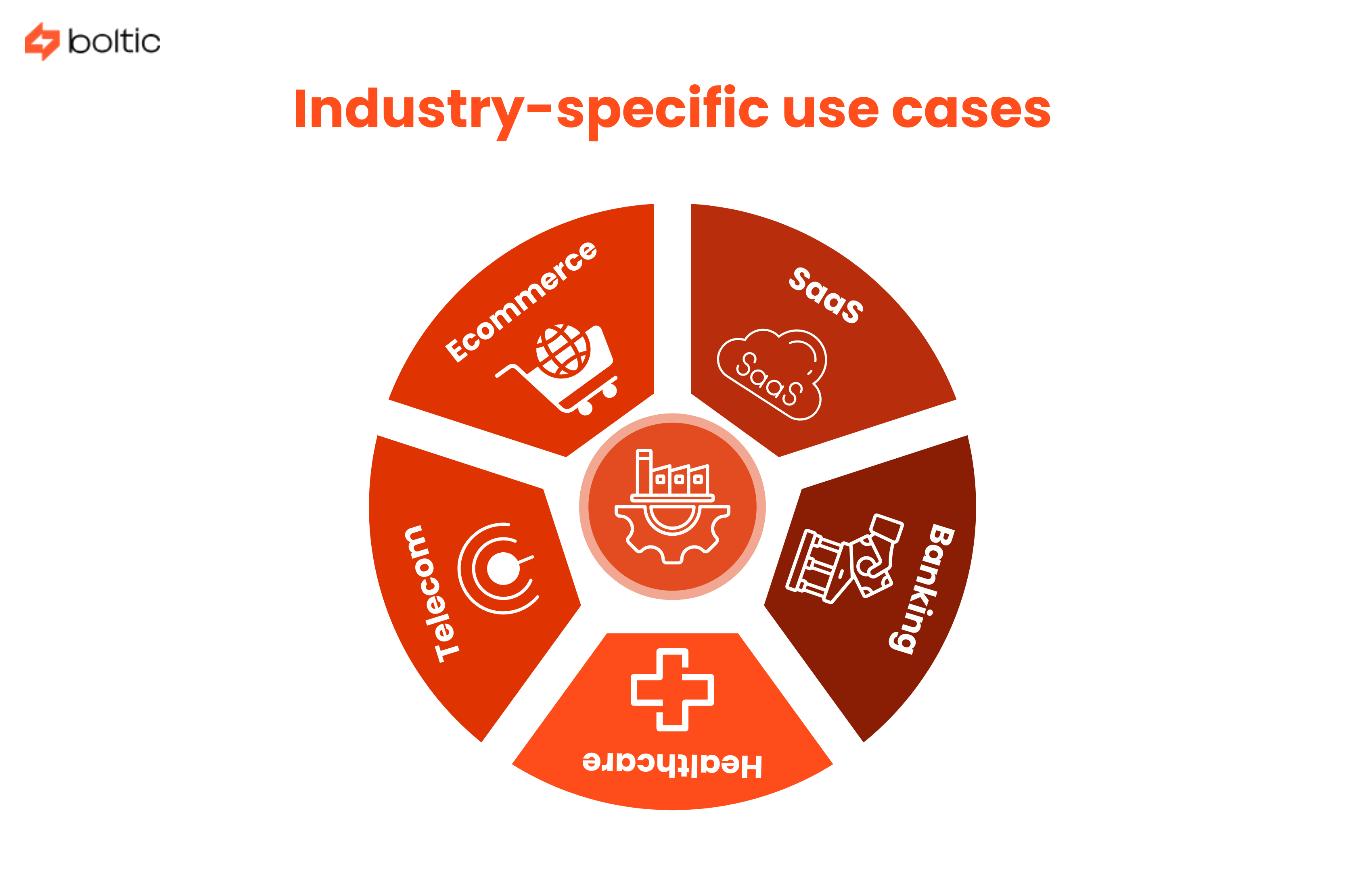
AI workflow automation is used across diverse industries. Every industry is different, and the workflow of AI can resolve these issues.
Ecommerce
The companies in e-commerce have large volumes of tickets, repeated questions, and tight deadlines. AI can handle:
- Order status updates
- Automation of refunds and returns
- Delivery tracking
- Product recommendation requests
Customers have instant responses, and the support staff attends to complicated issues such as spoiled orders or complaints.
SaaS
Onboarding, technical support and subscription management are handled by SaaS companies. AI automation helps with:
- Automated troubleshooting
- Feature guidance
- Usage analytics
- Account updates
AI enhances onboarding speed and minimises technical support workload.
Banking
Accuracy and compliance in banking support are required. AI automates:
- Fraud alert responses
- KYC verification queries
- Card replacement requests
- Transaction updates
This enhances security and lessens the operational load.
Healthcare
There are sensitive requests of patients in healthcare organisations. AI supports:
- Appointment scheduling
- Insurance queries
- Medical report tracking
- Pre-authorisation updates
Patients are attended to in less time without having to wait too long.
Telecom
Telecom companies experience network failures, changes in plans, and technical reasons. AI automates:
- Outage information
- Plan selection
- Sim activation status
- Device troubleshooting
This lessens the pressure of support in peak times.
Impact of AI automation on cost, speed & efficiency
AI is beneficial for optimal functioning and customer satisfaction. The various pros include -
- Reduced manual workload: AI automates repetitive tasks, including ticket tagging, writing responses, and finding information. This liberates the agents to concentrate on strategic/emotional interactions.
- Reduced response and resolution times: Workflows are automated and respond instantly. Unknown routing and prioritisation is powered by AI and minimises avoidable delays.
- Lower operational costs: Companies do not have to add people to teams as customer expansion occurs. AI is a volume manager that is less costly.
- Increased consistency and accuracy: The AI systems use rules consistently and minimise the differences due to human judgment. This guarantees customers a satisfactory response.
- Increased agent satisfaction: Agents will have less time working on routine tasks and more time working on significant challenges. This will curb burnout and boost morale.
AI + human collaboration in customer support
AI and humans do not work alone. They work together in order to provide a balanced and efficient support ecosystem.
One of the workflows that AI is used for is repetitive and rule-based, like the classification of tickets, writing of draft responses, and checking of status. Emotional cases, or context-heavy or complex cases, are dealt with by humans. The chat also helps the agents in live chat by offering accurate information instantly with the help of AI. This is a hybrid model that will guarantee customers speed and empathy.
The human agents are still crucial in conflict resolution, negotiation, and relationship-building processes. Delivering high-quality service that is given by AI enhances its capacity to achieve this objective by eliminating distractions and improving accuracy.
Top tools for AI workflow automation
There are several AI-based customer service systems that provide workflow automation. The tools most commonly used are:
- Zendesk AI
- Intercom Fin AI
- Freshworks Freddy AI
- Hubspot Service Hub
- Ada
- Ultimate
- Airkit
- Forethought
- Tidio AI
- Helpshift
All of these tools assist with automated routing, generation of responses, classification, agent assist and orchestration of workflows. This decision is determined by the needs of a business in terms of scale, complexity, and industry.
Challenges of automating customer support workflows
AI automation is associated with substantial advantages, yet companies have difficulties with its adoption.
- Being accurate with complicated questions: Incomplete training data can be misunderstood by AI. It should be updated and monitored on a regular basis.
- Keeping workflows up to date: Business processes evolve. Retraining of AI and updating of the working flows have to be frequently done.
- Not being overly automated: Excessive automation may be irritating to customers, particularly when they are facing emotional or unique problems. It must have a balanced human fallback.
- Managing data security: Sensitive data are usually contained in customer support screenshots, emails, and chat logs. Tight security controls are obligatory.
- Facilitating human escalation: The systems based on AI need to be able to transfer the cases to human agents appropriately. Handovers are poor and undermine customer trust.
drives valuable insights
Organize your big data operations with a free forever plan
An agentic platform revolutionizing workflow management and automation through AI-driven solutions. It enables seamless tool integration, real-time decision-making, and enhanced productivity
Here’s what we do in the meeting:
- Experience Fynd Boltic's features firsthand.
- Learn how to automate your data workflows.
- Get answers to your specific questions.