






Customer support has changed permanently. Customers no longer compare your support experience to your competitors. They compare it to the best experience they have had anywhere. Fast replies. Context-aware answers. No repeating information. No waiting on hold.
That shift is already reflected in how support teams operate. More than 80% of companies are either using or actively planning to adopt AI-powered chatbots for customer service, and customer support now accounts for the largest share of chatbot use cases globally.
The difference between a chatbot that frustrates customers and one that actually helps usually comes down to integrations, not AI capability. A chatbot on its own can answer questions. A chatbot that is integrated properly can resolve issues, trigger actions, and reduce pressure on your support team, without breaking trust.
This guide is not about replacing your support team or pushing full automation at all costs. It focuses on where chatbot integrations genuinely reduce load, where human agents still matter, and how teams avoid breaking trust while scaling support.
What “Chatbot Integration” Actually Means for Support Teams
Before talking about tools, it is important to clarify what chatbot integration really is, because this is where confusion starts.
A standalone chatbot can:
- Answer FAQs
- Route users to articles
- Collect basic information
An integrated chatbot can:
- Pull real-time data from support systems
- Update tickets, orders, or accounts
- Trigger workflows across tools
- Hand off conversations with full context
In simple terms, a chatbot without integration talks, and a chatbot with integration acts.
Most customer frustration does not come from bad answers. It comes from dead ends:
- “I can’t access that information.”
- “Please contact support.”
- “Let me transfer you.”
Chatbot integrations remove those dead ends by connecting the chat interface to the systems where real work happens.
Best Chatbot Integrations for Customer Support Teams (2026)
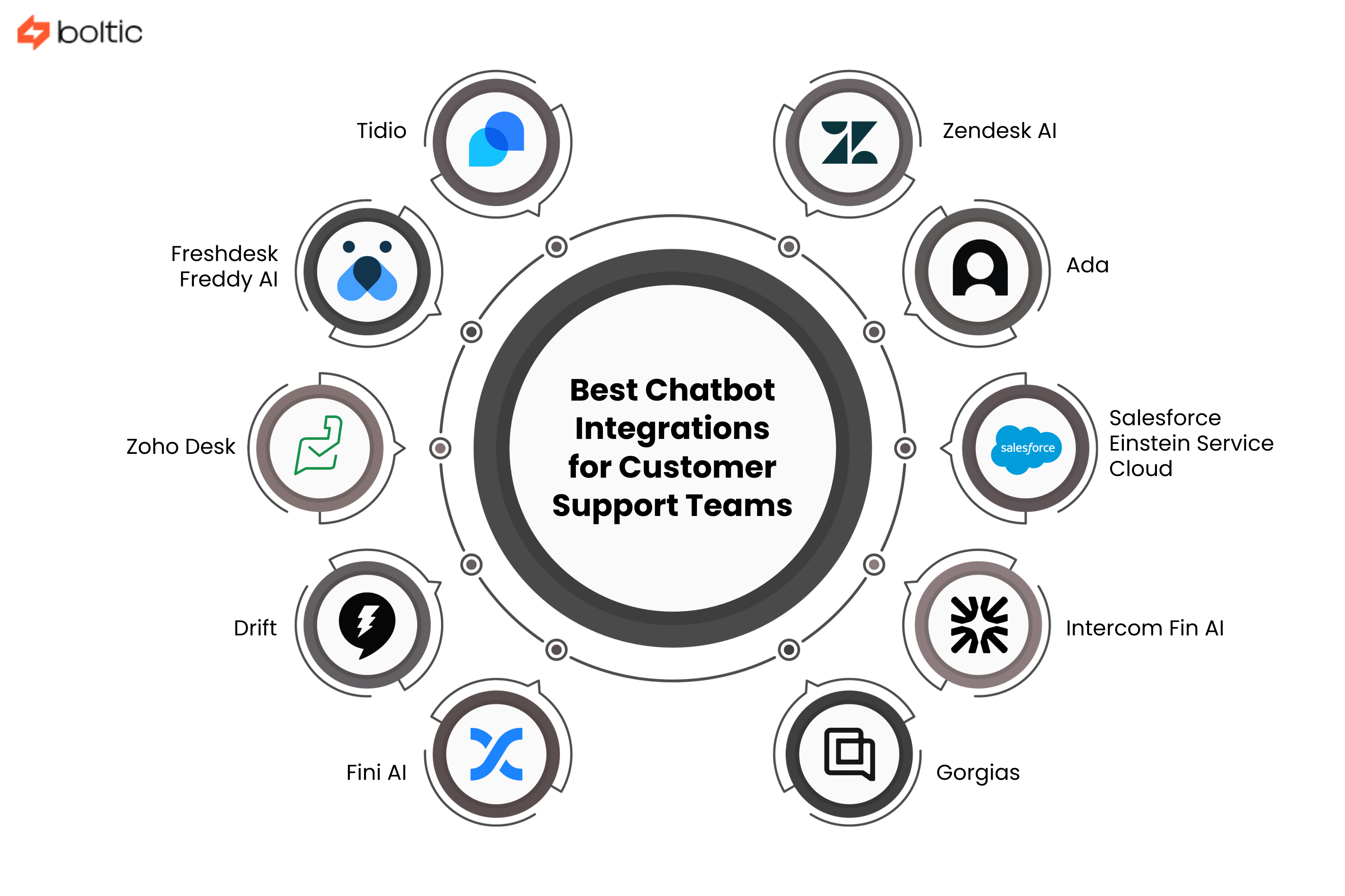
Below are the best chatbot integrations organized by team size and use case, based on how support teams actually operate.
For Enterprise Support Teams (100+ agents)
1. Zendesk AI - Best for large enterprises
Zendesk AI is the natural choice if Zendesk already sits at the center of your support operations.
Why it works
- Native integration with tickets, macros, and help centers
- AI-powered routing and summarization
- Omnichannel support across chat, email, social, and voice
Best for
- Large teams that need reliability and consistency
- Enterprises that can’t afford brittle automation
2. Ada - Best for automation-first teams
Ada is built for organizations aiming to automate a significant portion of conversations.
Why it works
- No-code flow builder
- Multi-step action execution
- Strong enterprise security posture
Best for
- High-volume support environments
- Teams pushing for 80%+ automation coverage
3. Salesforce Einstein Service Cloud - Best for Salesforce ecosystems
If Salesforce is your system of record, Einstein fits naturally.
Why it works
- Deep CRM data access
- Intelligent routing and classification
- Strong agent-assist capabilities
Best for
- Salesforce-first organizations
- Support teams tightly aligned with sales and account data
For SaaS and Product-led Support Teams
4. Intercom Fin AI - Best for modern SaaS support
Intercom remains the benchmark for in-app conversational support.
Why it works
- High-quality conversational UX
- Context-aware responses inside products
- Pay-per-resolution model rewards efficiency
Best for
- SaaS products with in-app support needs
- Teams prioritizing customer experience design
For e-commerce Support Teams
5. Gorgias - Best for Shopify and e-commerce brands
Gorgias is purpose-built for e-commerce support.
Why it works
- Deep order and refund integrations
- Revenue attribution from support conversations
- Unified inbox across channels
Best for
- Shopify, Magento, and BigCommerce stores
- Support teams handling order-heavy tickets
6. Tidio - Best budget-friendly option for small stores
Tidio offers an accessible entry point into chatbot automation.
Why it works
- Simple setup
- Visual flow builder
- Affordable pricing
Best for
- Small e-commerce teams testing automation
- Early-stage brands
For Mid-market Support Teams (10-100 agents)
7. Freshdesk Freddy AI - Best value for growing teams
Freshdesk hits a balance between cost and capability.
Why it works
- AI-assisted routing and triage
- Sentiment analysis
- Flexible pricing
Best for
- Teams outgrowing basic ticketing
- Cost-conscious organizations
8. Zoho Desk - Best for Zoho ecosystem users
Zoho Desk integrates tightly with the broader Zoho suite.
Why it works
- Unified customer context across Zoho apps
- Affordable plans
- Omnichannel support
Best for
- SMBs already using Zoho tools
- Teams wanting simplicity
Specialized Support Use Cases
9. Drift - Best for B2B sales + support overlap
Drift focuses on turning conversations into opportunities.
Why it works
- Conversational lead qualification
- CRM syncing
- Meeting scheduling
Best for
- B2B companies where support conversations influence revenue
10. Fini AI - Best for regulated industries
Fini AI prioritizes accuracy and compliance.
Why it works
- Zero-hallucination architecture
- Audit trails
- Multi-system integration
Best for
- Financial services
- Healthcare
- Compliance-heavy environments
Quick Decision Guide
Why Chatbot Integrations Matter, Specifically for Customer Support Teams
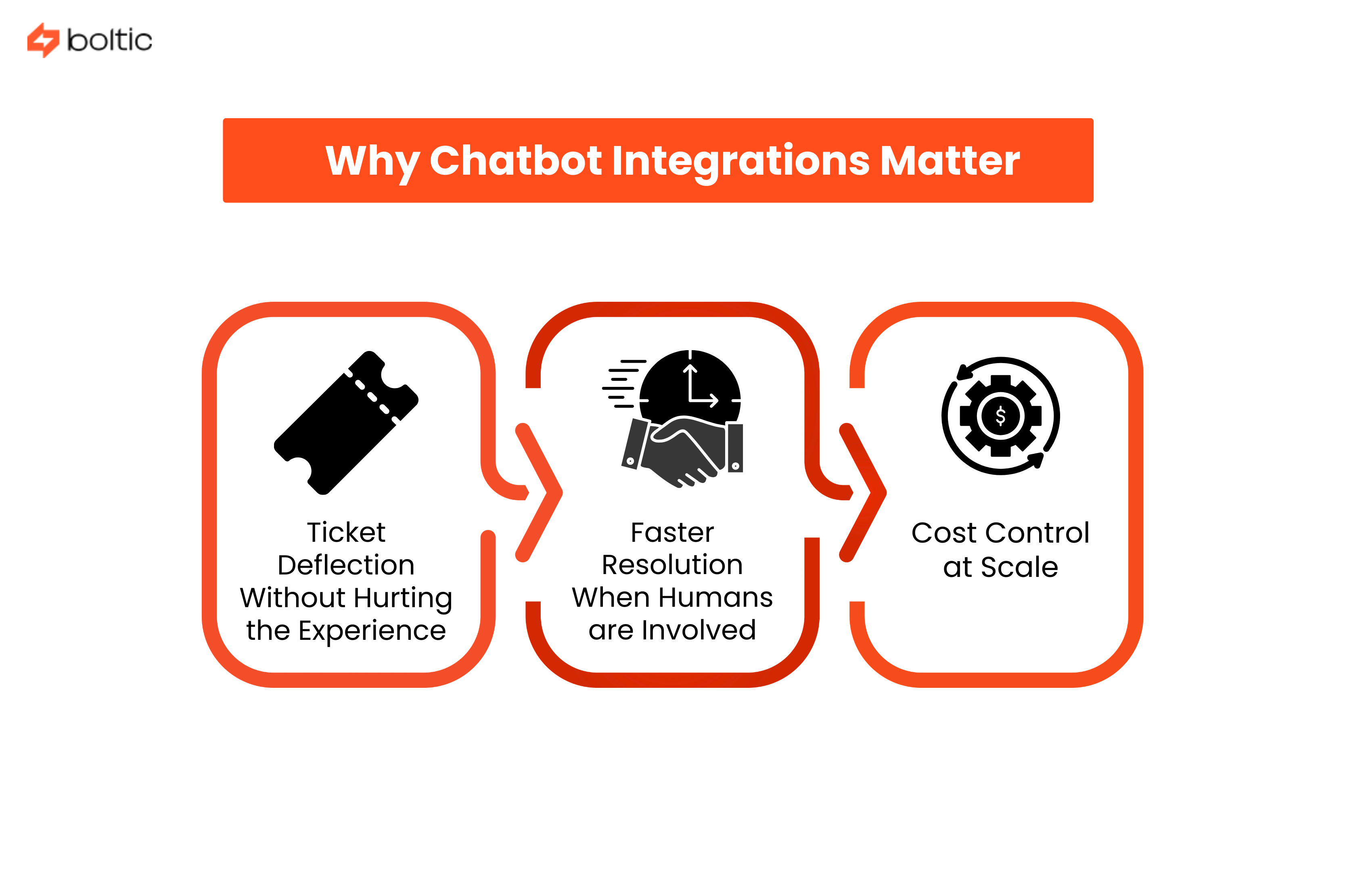
Customer support teams operate under three constant pressures:
- Volume keeps increasing
- Response-time expectations keep shrinking
- Budgets don’t scale at the same pace
This is where chatbot integrations change the math.
1. Ticket Deflection Without Hurting the Experience
Well-integrated chatbots can resolve routine issues end-to-end:
- Order status
- Password resets
- Subscription changes
- Refund requests
Industry data shows that 70-80% of routine queries can be resolved by chatbots when integrations are set up correctly. That is not deflection through frustration, as it is deflection through resolution.
2. Faster Resolution When Humans are Involved
Even when a chatbot escalates to a human agent, integration matters.
Instead of:
- Repeating information
- Asking the same questions
- Searching across tools
Agents receive:
- Conversation history
- Customer context
- Relevant system data
This leads to faster first responses and shorter resolution times.
3. Cost Control at Scale
On average:
- A chatbot interaction costs around $0.50
- A human-handled interaction costs around $6.00
That difference compounds quickly at scale, especially for growing teams.
How to Choose the Best Chatbot Integrations
There is no single “best chatbot integration” for every team. Context matters more than feature lists. Here’s a simple decision framework that supports leaders can use.
1. Team Size and Ticket Volume
- Small teams need simplicity and cost control
- Mid-market teams need flexibility and automation depth
- Enterprise teams need reliability, compliance, and scale
2. Support Channels
- Website chat only?
- In-app messaging?
- Email, social, WhatsApp, voice?
Omnichannel support increases integration complexity fast.
3. Existing Support Stack
- Zendesk?
- Salesforce?
- Shopify?
- Internal tools?
The best chatbot integrations usually extend what you already use.
4. Compliance and Accuracy Requirements
Highly regulated industries require:
- Audit trails
- Controlled actions
- Zero hallucination risk
Not every chatbot is built for that.
Integration Depth Matters More Than Chatbot UI
Most chatbot projects don’t fail because of conversation quality.
They fail because:
- Backend systems are fragmented
- Data is inconsistent
- Workflows break under edge cases
Chatbot platforms are excellent at conversation. They are not designed to orchestrate complex backend systems.
As support automation grows, teams often need:
- Workflow validation
- Multi-step execution
- Safe handling of edge cases
- Cross-system data consistency
This is where backend orchestration becomes critical.
Where Boltic Fits
Boltic is not a chatbot integration platform. It does not:
- Provide chat interfaces
- Replace support chat tools
- Act as a conversational AI layer
What Boltic does well is everything behind the scenes.
How Boltic Supports Chatbot Integrations Indirectly
When support chatbots need to:
- Sync data across systems
- Trigger reliable workflows
- Validate actions before execution
- Coordinate across multiple tools
Boltic acts as the execution and orchestration layer.
Examples:
- A chatbot triggers a refund → Boltic validates data and executes the workflow safely
- Support data flows between tools without manual syncing
- AI agents perform actions with guardrails, not blind automation
This allows chatbot tools to focus on conversation while Boltic handles reliability.
Many teams prefer combinations:
- Chatbot tools for interaction
- Support platforms for visibility
- Boltic for orchestration and execution
Common Mistakes Support Teams Make With Chatbot Integrations
1. Automating before fixing workflows
Automation amplifies existing problems. Broken workflows break faster when automated.
2. Treating chatbots as replacements
The best results come from human + AI collaboration, not replacement.
3. Ignoring backend complexity
Edge cases, retries, and data inconsistencies matter more at scale.
4. Measuring only deflection
Resolution quality matters more than deflection numbers.
The Future: From Chatbots to Agentic Support Systems
Support is moving toward agentic AI:
- AI agents that reason
- Plan multi-step actions
- Execute workflows across tools
This future depends less on chat UI and more on integration architecture.
Systems that can:
- Safely execute actions
- Maintain auditability
- Coordinate across tools
Will define the next generation of customer support. So, always connect to the best support systems.
Conclusion
Chatbot integrations are no longer optional for customer support teams. They are foundational. The teams that succeed don’t automate everything at once. They:
- Choose tools based on context
- Invest in integration depth, not just chat interfaces
- Combine conversational AI with reliable backend execution
Chatbots start conversations. The best integrations make sure the right systems finish them reliably, visibly, and without creating new failure points.
drives valuable insights
Organize your big data operations with a free forever plan
An agentic platform revolutionizing workflow management and automation through AI-driven solutions. It enables seamless tool integration, real-time decision-making, and enhanced productivity
Here’s what we do in the meeting:
- Experience Fynd Boltic's features firsthand.
- Learn how to automate your data workflows.
- Get answers to your specific questions.


