







Imagine a finance team where invoices do not pile up, forecasts update themselves whenever there is a shift in the market, fraud alerts matter and compliance does not feel like firefighting. That is the promise of finance AI automation.
At its core, finance AI automation brings together AI in finance, Machine Learning (ML), Natural Language Processing (NLP) and generative AI with automation technologies like RPA as well as workflow engines.
The result is intelligent automation in finance that does not just follow rules, but even understands patterns, predicts outcomes and supports better decisions across enterprise finance as well as BFSI operations.
From the CFO’s office to banking contact centres, AI powered banking automation is quietly reshaping how money moves, risks are managed, and customers are served.
What Is Finance AI Automation?
Finance AI automation refers to the use of AI-driven models embedded into automated workflows across finance and financial services. There are two broad lenses to understand it:
Enterprise finance automation
This focuses on internal finance functions such as:
- AI for accounts payable / AP automation
- AI for accounts receivable / AR automation
- Close, reconciliations, and reporting
- AI in financial planning and analysis (FP&A)
BFSI operational automation
This applies to external, customer-facing and risk-heavy workflows such as:
- AI in banking operations
- Lending, payments, and servicing
- AI in KYC and AML
- Fraud detection, compliance, and claims processing
Traditional automation follows rules. Intelligent automation in BFSI adds judgment, classifying documents, scoring risk, prioritising cases, and recommending next actions.
Automation layer
Workflow engines as well as RPA tools that perform actions, i.e., post entries, route approvals, trigger alerts, or generate any reports.
All together, these layers turn static processes into adaptive systems that learn plus ameliorate over time.
How Does Finance AI Automation Work?
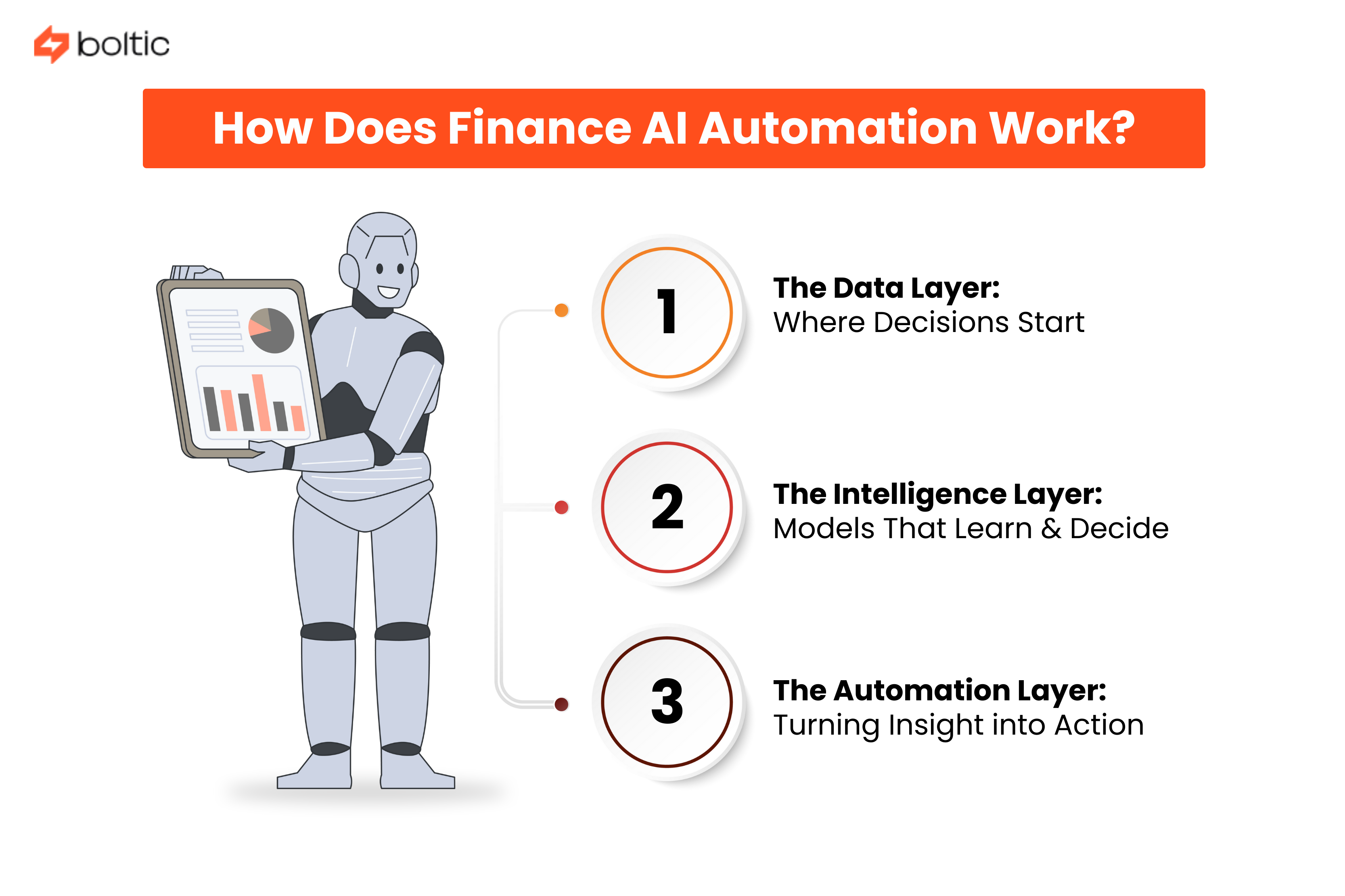
At a practical level, finance AI automation functions by blending intelligence with proper execution. In place of finance as well as BFSI processes depending just on fixed rules/manual judgment, AI-enabled systems learn from data, apply pragmatic context, and trigger actions in an automatic manner. The goal is very simple: move from after-the-fact processing to actual-time and decision-led workflows.
To understand how this functions in regular operations, note that breaking down finance AI automation into three connected layers is crucial.
1. The Data Layer: Where Decisions Start
Every financial and banking process begins with proper data. This involves:
- Structured data, i.e., transactions, ledgers, balances, as well as customer records
- Unstructured data, i.e., invoices, contracts, emails, call logs, as well as identity documents
Finance AI automation first brings such data sources all together, cleans them up and makes them usable. For instance, invoice PDFs are converted into well-structured fields, transaction histories are standardised, and customer info is linked throughout systems. Without this, automation remains brittle as well as limited.
2. The Intelligence Layer: Models That Learn & Decide
Once data is usable, then AI models step in to interpret it. Such models do not just follow instructions; they figure out patterns and make informed judgments.
In finance and BFSI contexts, this involves:
- Classification models that sort invoices, documents or support tickets
- Prediction models that figure out risk, cash flow or future performance
- Anomaly detection models that flag out unusual transactions or behaviours
Here is where AI adds actual value. In place of asking, "Does this match a rule?" systems ask, "Does this appear normal, risky or worth attention?”
3. The Automation Layer: Turning Insight into Action
Insights do not make changes to any outcome. The automation layer connects well-made AI decisions to actual actions via workflows as well as activity.
Automated actions are:
- Routing out essential approvals to the appropriate person
- Posting entries to finance platforms as well as systems
- Triggering out any alerts as well as investigations
- Updating forecasts as well as dashboards
For example, if an AI model flags out a transaction as high-risk in nature. An automated workflow can quickly open a case, assign it to the appropriate team, and log the activity for audit purposes without waiting for any manual intervention.
Where Finance AI Automation Is Applied?
Such three layers come altogether through essential finance and BFSI operations:
- Risk management: figuring out fraud, monitoring transactions, as well as prioritising alerts
- Operations: automating AP, AR, reconciliations, onboarding, as well as service workflows
- Planning and analysis: permitting continuous forecasting, scenario modelling, as well as performance tracking
In every case, finance AI automation shifts teams away from repetitive work, toward oversight, evaluation/decision-making.
Why Does This Model Work?
Finance AI automation succeeds as it mirrors how individuals work. Humans accumulate info, interpret it and act. AI-enabled systems do the same at scale with consistency & without any kind of fatigue.
When data, models plus automation are well aligned, finance and BFSI teams acquire faster cycles, better control, and insight without losing out on transparency/accountability.
Finance Automation vs Intelligent Automation vs AI in Banking Operations
This distinction matters as AI and RPA in banking operate in regulated, high-stakes environments where explainability as well as governance are critical.
What Are the Benefits of AI in Financial Services?

Throughout finance teams as well as BFSI institutions, AI in banking and finance use cases consistently deliver:
- Faster cycle times in AP, AR, as well as close
- Lower error rates as well as fewer manual interventions
- Better risk detection plus fewer false positives
- Ameliorated customer experience via faster responses
- More strategic finance teams concentrated on insight and not data chasing
In short, AI finance automation tools assist teams in doing less processing as well as thinking.
AI Automation for the Office of the CFO
Contemporary CFOs oversee far more than accounting. They own performance, risk, as well as strategy. Here is where intelligent automation in finance delivers actual leverage.
Transactional finance: AP, AR and expense management
AI permits:
- Invoice capture utilising OCR plus NLP
- Duplicate as well as fraud detection
- Automated three-way matching
- Prudent approval routing
- AI-driven credit as well as collection recommendations
The outcome: faster payments and healthier cash flow, as well as reduced leakage.
Record to report: close, consolidation and reconciliations
AI supports finance teams by:
- Suggesting reconciliation matches
- Flagging unusual entries
- Highlighting unexplained variances
- Assisting with automated postings
Close cycles shrink while confidence in numbers ameliorates.
Planning, forecasting, and scenario analysis (FP&A)
With AI-driven forecasting plus scenario analysis, finance teams can:
- Move from static budgets to rolling forecasts
- Run “what-if” simulations in just a matter of minutes
- Figure out drivers behind variance, as well as not just outcomes
Which Finance Processes Can Be Automated with AI?
- AP & AR
- Close as well as reconciliations
- Forecasting as well as planning
- Management plus regulatory reporting
Each delivers efficiency gains while minimising operational risk.
AI in Banking Operations: Front, Middle, and Back Office
In the BFSI vertical, automation must balance out speed with trust. AI in banking operations is embedded throughout:
Customer support clubbed with servicing
AI chatbots in banking/virtual assistants can:
- Manage routine-related queries
- Classify intent
- Assist agents with recommended responses
Customers get faster assistance; agents manage complex cases.
Payments, transfers, and operations workflows
AI monitors transactions on an actual-time basis, figures out exceptions as well as triggers automated workflows for disputes and chargebacks, minimising delays plus operational friction.
Credit and lending operations
From onboarding to servicing, AI supports:
- Document evaluation
- Automated underwriting
- Risk-related pricing
- Early warning systems for delinquency
Here is where AI powered banking automation affects profitability directly.
BFSI Workflow Automation: End-to-End Use Case Playbooks
BFSI workflow automation connects well with AI decisions and operational execution.
Customer onboarding as well as KYC workflows
AI manages:
- Document OCR/validation
- Figure out verification
- Risk scoring
Automation manages:
- Case routing
- Approvals
- Account setup
How Does AI Help with KYC/AML?
AI ameliorates KYC/AML by:
- Linking entities throughout data sources
- Figuring out any suspicious patterns
- Prioritising cases that have a high risk
- Permitting continuous monitoring
Claims processing as well as servicing (insurance)
AI accelerates intake, flags out any kind of potential fraud/automates settlement for low-risk claims, which cuts down on turnaround times on a dramatic basis.
IT and Operations Workflow Automation in BFSI
Behind every smooth banking/insurance experience sits a complex IT, acting with essential operations, core banking systems, payment gateways, CRM platforms and risk engines/regulatory systems. These remain available all the time. In the BFSI platform, even a short disruption can result in financial loss, regulatory scrutiny or customer trust erosion. Here is where IT plus operations workflow automation in BFSI becomes essential.
Traditionally, IT operations depend on manual monitoring, reactive ticket handling, and fixed escalation rules. AI-powered banking automation changes this by making a proper shift to IT operations from reactive firefighting to predictive/self-healing workflows.
AI for Risk, Fraud, and Compliance in Financial Services
Risk sits at the core of financial services. Each and every transaction, loan approval, customer onboarding and regulatory report carries out financial, operational/reputational exposure. Here is why AI for risk, fraud plus compliance has become one of the practical as well as high-impact applications throughout banks, insurers plus BFSI institutions.
In place of replacing risk teams, AI strengthens them, which assists in figuring out what requires attention with higher accuracy. Note that routine evaluations/noise are better managed in the background.
How Is AI Used in Fraud Detection in Banking?
Fraud has evolved from rule-breaking to quickly moving and sophisticated patterns. Static rules struggle to keep up. AI addresses this by concentrating on behaviour and not just thresholds.
AI-driven fraud detection functions in the following way:
- Anomaly detection, where unusual transaction patterns are flagged out. It is flagged depending on historical norms
- Behavioural profiling, which looks at how customers transact/highlights deviations
- Prudent alert prioritisation, which ranks alerts by risk in place of flooding teams with unusually false alarms
The biggest gain here is accuracy. By minimising false positives, investigation teams spend a lot of time on genuinely high-risk scenarios in place of clearing noise. This results in quicker response times as well as minimised fraud losses.
Credit Risk Modelling and Early Warning Systems
Credit risk does not begin when a borrower defaults; it builds quietly over a long time period. AI assists institutions in spotting early indications of stress as well as intervening before issues escalate.
Applications are:
- AI-associated credit scoring, blending conventional financial data with broader behavioural signals
- Probability of Default (PD)/Loss Given Default (LGD) estimation, updated dynamically as conditions change with time
- Customer-level early warning signals, in the form of payment behaviour shifts/accountancy even changes
Such insights permit lenders to intervene early, make adjustments to credit terms, which involve customers in a proactive manner or strengthen provisions in place of reacting to post-damage.
Regulatory Compliance and Reporting Automation
Compliance teams witness growing volumes of data, tighter timelines, and enhanced total scrutiny. AI supports them by automating the time-consuming parts of the process while ameliorating consistency.
Applications are:
- Scanning transactions/communications for suspicious patterns
- Flagging out activities that require regulatory evaluation
- Automatically compiling audit-ready reports
- Supporting parts of regulatory filings with well-structured and traceable data
The outcome is not just speed but confidence; reports are consistent, auditable, and easier to defend in the course of inspections.
How Do Banks Manage AI Model Risk and Compliance?
Utilising AI in well-regulated environments requires discipline. Banks manage AI-associated risk via structured model risk management practices, which involve:
- Model evaluation before any kind of deployment
- Periodic performance testing as well as recalibration
- Clear documentation of assumptions
- Frequent assessment of drift or unanticipated behaviour
Oversight sits with cross-functional governance groups that bring all together, i.e., risk, compliance, technology and business leaders, which ensure accountability without slowing down on innovation.
Governance, Explainability, and AI Risk Management in BFSI
As AI becomes embedded in crucial decisions, governance acts as an essential differentiator between trustworthy systems and risky experimentation. Pragmatic governance structures assist in turning AI from a concern into a well-controlled capability.
Regulatory Expectations Around AI in Finance
Throughout markets, regulators frequently concentrate on essential principles. These are:
- Fairness, which ensures decisions do not cause a disadvantage to particular groups
- Transparency, so that the outcomes can be explained/reviewed
- Accountability, with clear ownership for AI-associated decisions
- Data protection, safeguarding sensitive financial/personal info
Such expectations mould how AI systems are well-designed, deployed and assessed in BFSI environments.
Building an AI Governance Framework
Effective governance begins with crystal clear roles. BFSI institutions are:
- Risk leaders overseeing the integrity of the model
- Technology leaders, who make sure secure & scalable systems
- Data leaders, who manage quality & access
- Business leaders, who validate actual impact
Responsibilities usually cover model approvals, exception management, periodic assessment, as well as escalation pathways, which make ownership explicit rather than assumed.
Explainability, Monitoring and Bias in AI Models
In the field of finance, black box decisions are acceptable models. This is explainable enough for regulators, auditors/internal teams to better understand why an outcome occurred.
Good practices are:
- Documenting how models function & what kind of data they can utilise
- Providing human-readable explanations for prudent decision-making
- Assessing performance over a long time period to figure out any drift
- Testing outcomes throughout customer segments to identify any sort of bias
This continuous oversight assists in keeping AI well aligned with business goals/standards that are ethical in nature.
Is AI Safe in Financial Services?
AI is totally safe when it is well-governed, monitored, and paired with human judgment. Prudent model controls, transparent decisioning, plus active oversight make AI a reliable instrument in place of a hidden risk.
ROI and Business Case for Finance AI Automation
Adoption decisions focus on prudent value. Leaders want to be well aware of whether financial AI automation yields returns that are measurable and not just technical sophistication.
Is AI Automation Expensive for Banks and Finance Teams?
Expenditures that incur from:
- Software & platform licenses
- Cloud infrastructure
- Integration with prevailing systems
- Change management & training
Benefits are:
- Minimised effort that is manual
- Reduced fraud/any error losses
- Quicker cycle times
- Ameliorated customer/employee experience
Core ROI Levers and KPIs
Return on Investment (ROI) must be tracked well throughout distinct functions. These functions are where:
- Finance teams concentrate on close timelines, days payable or receivable, as well as hours saved
- Banking operations track fraud losses/non-performing loans plus service metrics
- BFSI workflows look at cycle times, error rates/compliance findings
Crystal clear, consistent measurement turns anecdotal wins into credible, well-defined business cases.
Designing Pilots and Experiments That Prove Value
Successful pilots are well-focused plus measurable in nature. Prudent practices are:
- Comparing workflows that are automated and non-automated
- Running pilots to capture well-defined patterns
- Tracking efficiency as well as risk outcomes
Well-designed pilots build good confidence plus build momentum for the purpose of scaling.
Implementation Roadmap and Maturity Model for Finance AI Automation
Implementation works well if it is looked at as a journey. And certainly not as a single project.
How Do You Implement AI Automation in Finance and BFSI?
Most organisations move through essential phases. These phases assist in:
- Figuring out impact use cases
- Preparing data
- Selecting tools that are aligned well with risk
- Running pilots with prudent governance
- Expanding & continuously ameliorating
Each and every phase builds up good capability with zero need for overwhelming teams.
30–60–90 Day Plan for Starting Finance AI Automation
- Initial thirty days: Concentrate on quick wins, i.e., invoice capture, Frequently Asked Questions (FAQs) chatbots & fundamental alerting
- Next sixty days: Extend into approvals, reconciliations & assessments
- By ninety days: Manage well higher value risk as well as compliance workflows
This staged approach balances out speed with control.
Finance AI Automation Maturity Levels
Organisations progress from:
- Manual processes
- Isolated automations
- AI-assisted workflows
- Thoroughly governed & enterprise-wide platforms
Each and every level brings about better consistency, scalability plus prudent insight.
Choosing Finance AI Automation Platforms and Tools
Tool selection shapes success over the long term, particularly in a well-regulated environment.
Tool Categories in Finance and BFSI Automation
Essential categories are:
- Finance automation platforms for AP, AR, and expenditures
- AI ERP/performance management tools
- Banking-focused platforms for fraud, Know Your Customer (KYC) & risk
- Workflow as well as RPA platforms
- Conversational tools for customer & employee support
The appropriate blend must be based on scale, complexity, and regulatory requirements.
Evaluation Checklist for Finance AI Automation Vendors
Criteria to examine:
- BFSI experience plus regulatory understanding
- Integration with prevailing systems
- Explainability plus audit support
- Security/scalability
- Ownership cost plus implementation support
Example Stacks for Mid-Market vs Large BFSI Institutions
Mid-market organisations blend perfectly focused automation tools with lightweight AI potential. Larger institutions function on integrated platforms with shared governance, data layers, and enterprise-wide monitoring.
The goal in such scenarios is the same: reliable automation that scales in a safe manner with the enhancement of complexity.
drives valuable insights
Organize your big data operations with a free forever plan
An agentic platform revolutionizing workflow management and automation through AI-driven solutions. It enables seamless tool integration, real-time decision-making, and enhanced productivity
Here’s what we do in the meeting:
- Experience Fynd Boltic's features firsthand.
- Learn how to automate your data workflows.
- Get answers to your specific questions.



.png)