

In 1951, Maurice Wilkes and David Wheeler introduced the term “API” to the mainstream tech space. Until then, API integrations were largely understood as a blanket method to communicate across applications. In their book called “The Preparation of Programs for an Electronic Computer.” Wilkes and Wheeler provided foundational descriptions of several computing terms. API integration was among them. This was the beginning of a revolution in the world of databases.
In the decades that followed, API integrations would transform connectivity. Sourcing information and getting credible responses became easier. Language and geographical barriers were eliminated with the help of these technological translators. For all its history & undeniable role in our regular online activities, what really are API integrations? In this guide, we’re going to start from scratch and delve into that question.
What is an API?
In order to understand API integrations, you need to have clarity on what an API is. Expanding to Application Programming Interface, an API can be imagined as a middleman in data exchange. Imagine you ask a question whose answer you cannot immediately and independently access. You pose the question to a person who, in turn, knows an expert on the subject. They convey your question to the expert, get the answer, and communicate it back to you. This link between yourself and the expert can be understood as the API. The only difference is that in practice, applications/databases/systems are involved in placing requests and storing information instead of you or a human expert.
It acts as an intermediary for the exchange of data and allows businesses to obtain information from existing data sources. Developers and businesses are not required to build databases or make data entries from scratch but can fast-track that process for efficiency and scalability.
Why You Need API Integration
When two or more applications/databases/software systems are connected and permitted to exchange data and functionality based on agreed-upon rules, that process is called API integration. Your business can make use of API integration:
- To connect multiple software systems
- To source accurate and credible data from a business’s non-native data sources
- To improve efficiency by automating data exchange
- To boost scalability as the business grows
- For improved security and data protection
But how does API integration execute all of these functions? Right, let’s go there.
How API Integration Works
Understanding the workings of API integration is useful when you’re looking to automate a significant portion of manual data exchange tasks for your business.
Components in API Integration
Apart from applications that an API acts as an intermediary between, the integration of API can be understood through a few components:
- API - The intermediary, which has been programmed to exchange data on certain agreed-upon rules.
- Client/Requesting Party - The application/system that places a data request with the API.
- Request - It is the question/data query placed with the API that it is meant to convey and source information for.
- Endpoint/Responding Party - The specific API endpoint (URL) exposed by a server or system that processes the request and retrieves or modifies data, often interacting with underlying databases or services.
- Response - The answer to the data request that the API relays back to the client or the requesting system.
How API Integrations Function Behind The Scenes
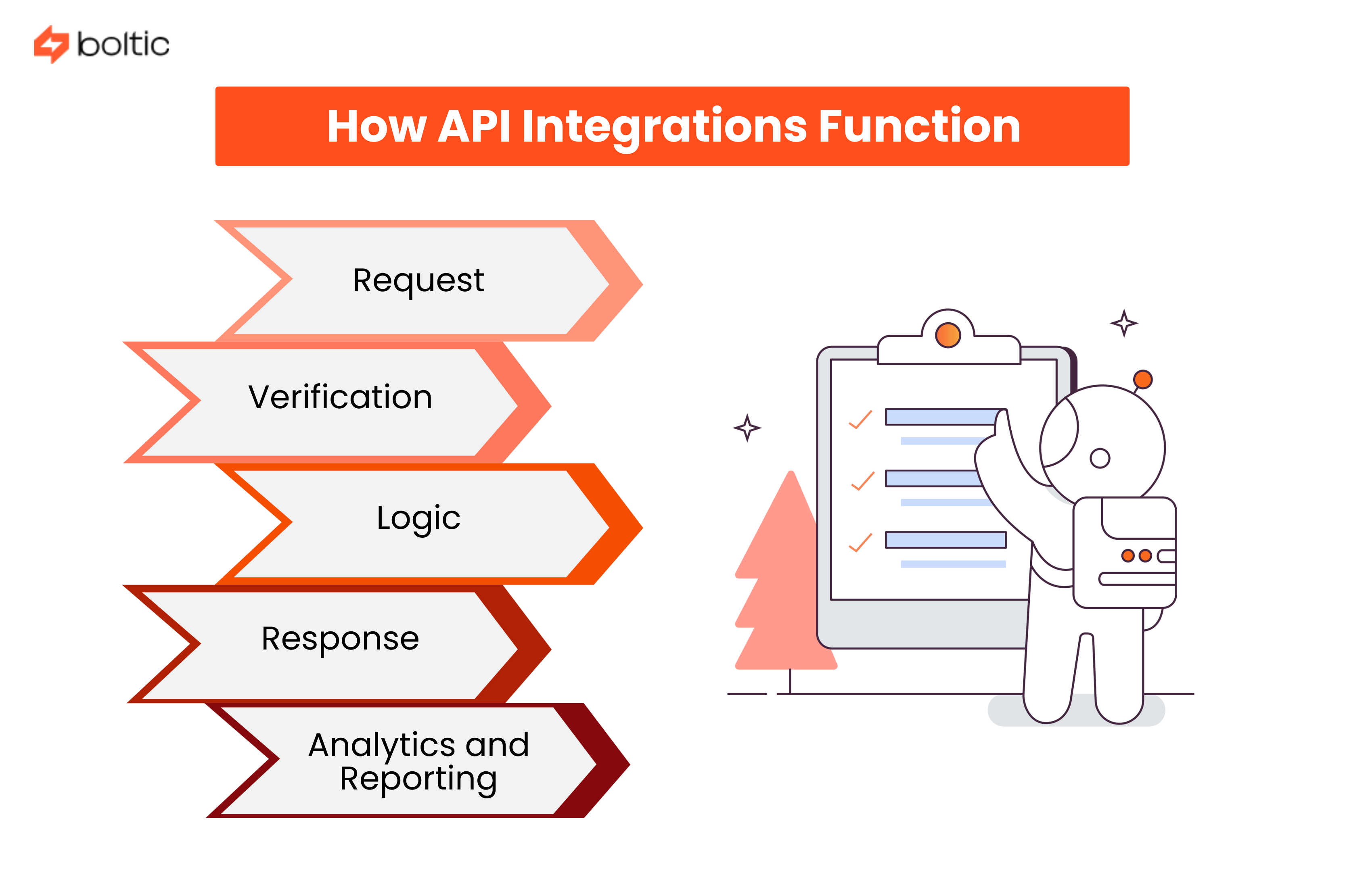
Here’s how API integrations work in real time for the exchange of data and functionality:
Step 1: Request
Using HTTP or Hypertext Transfer Protocol, one system is able to place a data request to another’s API. This data request tends to contain information like an endpoint URL, an API key, and an action or method that needs to be performed for a successful request.
Step 2: Verification
In the second step, the integrated API verifies the information in the data request. It tallies whether the requested information complies with the rules of exchange between the two systems. Based on that, it either validates and permits the request to move to the next step or displays an error message for the original client.
Step 3: Logic
In case of a rule-compliant and verified request, the API runs the next step. It carries out the required logic or action in response to the request, which may involve reading, writing, updating, or deleting data.
Step 4: Response
Data or messages are relayed to the client or requesting system through the API. In case data is unavailable, it displays an error message to the client.
Step 5: Analytics and Reporting
Based on the response the client/requesting system receives from the endpoint/responding system, the client is able to incorporate the data received. It either chooses to opt for storage or triggers the next API call/request.
If you intend to scale your business through data exchange, automation adds a layer of efficiency that can provide an operation boost. Through automation, you can eliminate the need to place API requests manually and orchestrate the functioning of multiple APIs integrated into your business workflow. On detecting triggers, workflows and data exchange are initiated automatically through integrated APIs. Multiple requests and responses are smoothly executed by combining automation with API integrations.
Uses of API Integration in Industries
Due to the seamless communication that API integration provides, it is being widely used across industries to accelerate routine business processes. Here are some industries where API integrations are heavily used:
1. E-commerce
Retail businesses and e-commerce enterprises use API integration:
- To connect to a centralized inventory management system
- To update order-related information automatically
- To increase the ease of making payments through secure gateways
2. Advertising
The marketing and advertising industries also adopt API integrations for several reasons.
- Enables easy login or sign up
- Helps gauge customer sentiments
- Syncs ad-related data on multiple social media platforms
- Enables analytics and reporting tasks
3. Healthcare
Medical institutions and healthcare businesses stand to gain much through API integrations.
- Easy access to patient data from EHR or electronic health record systems
- Secure exchange of data between one or more healthcare providers
- Syncing patient data from various departments to a single portal
4. Finance Institutions
Banking and Finance institutions benefit from API integrations.
- Secure transactions and updates
- Organized management of payment-related data in accounting systems
- Flagging instances of fraud as and when they occur
5. Tech Enterprises
SaaS businesses and enterprises operating in the tech space use API integrations:
- Manage data across multiple tools and systems
- Automate app-related alerts and customer onboarding activities
- Make uniform and timely updates across systems
As is evident, API integrations are non-negotiables in a world where businesses are automating data exchange processes rapidly.
Benefits of API Integration for Data Teams & Businesses
Automating the bulk of your business's data exchange tasks with the help of API integrations can have a positive growth impact on your business. Here are a few key benefits you stand to gain from using API integrations in automated business workflows:
Improved Efficiency
Through quick and seamless exchange of information between systems and applications, API integrations help boost the efficiency of your business. Human agents are no longer required to deal with data updates manually. It saves time and accelerates the execution of workflows. When API integration tackles communication, your human team can focus on strategy and creativity.
Data Credibility
API integrations enable the exchange of data and functionality through processes involving verification. This ensures that credible information is shared between authentic parties. Additionally, integration of API with quality databases or systems lets businesses access reliable data in real time. Latest updates are shared as well as synced. By removing the aspect of manual data entry, it also reduces the margin for error and ensures high accuracy.
Scalability
API integrations have removed the need for developing or building databases or services from scratch. They enable your business to place multiple API calls and initiate several requests to other systems/applications at the same time. Through automation, it can be incorporated into operational processes for tackling a high volume of requests. This enhances the scalability and supports the growth of your organization.
Enhanced CX
When used in automated workflows for business operations, API integration can help generate responses in a speedy manner. It can access data quickly and allow personalization of responses before they are relayed to the customer. In case of queries, it provides prompt resolutions to problems. Your business is able to boost its goodwill, thus, by reducing wait times and delivering responses instantly.
Security
When integrated, APIs use a verification mechanism to ensure that an authenticated party is initiating the communication. It acts as a filter for detecting fraud or unauthorized systems trying to access sensitive information. This helps keep customers as well as additional business data protected and ensures the secure exchange of information.
Cost-Effectiveness
Reduced possibility of error, higher efficiency, and elimination of manual data exchange have enabled businesses to save significantly on costs. Your business applications/systems do not require custom development when API integrations can successfully utilize existing databases/software systems for operations. In the long term, your business is able to leverage the cost savings in favour of more productive activities.
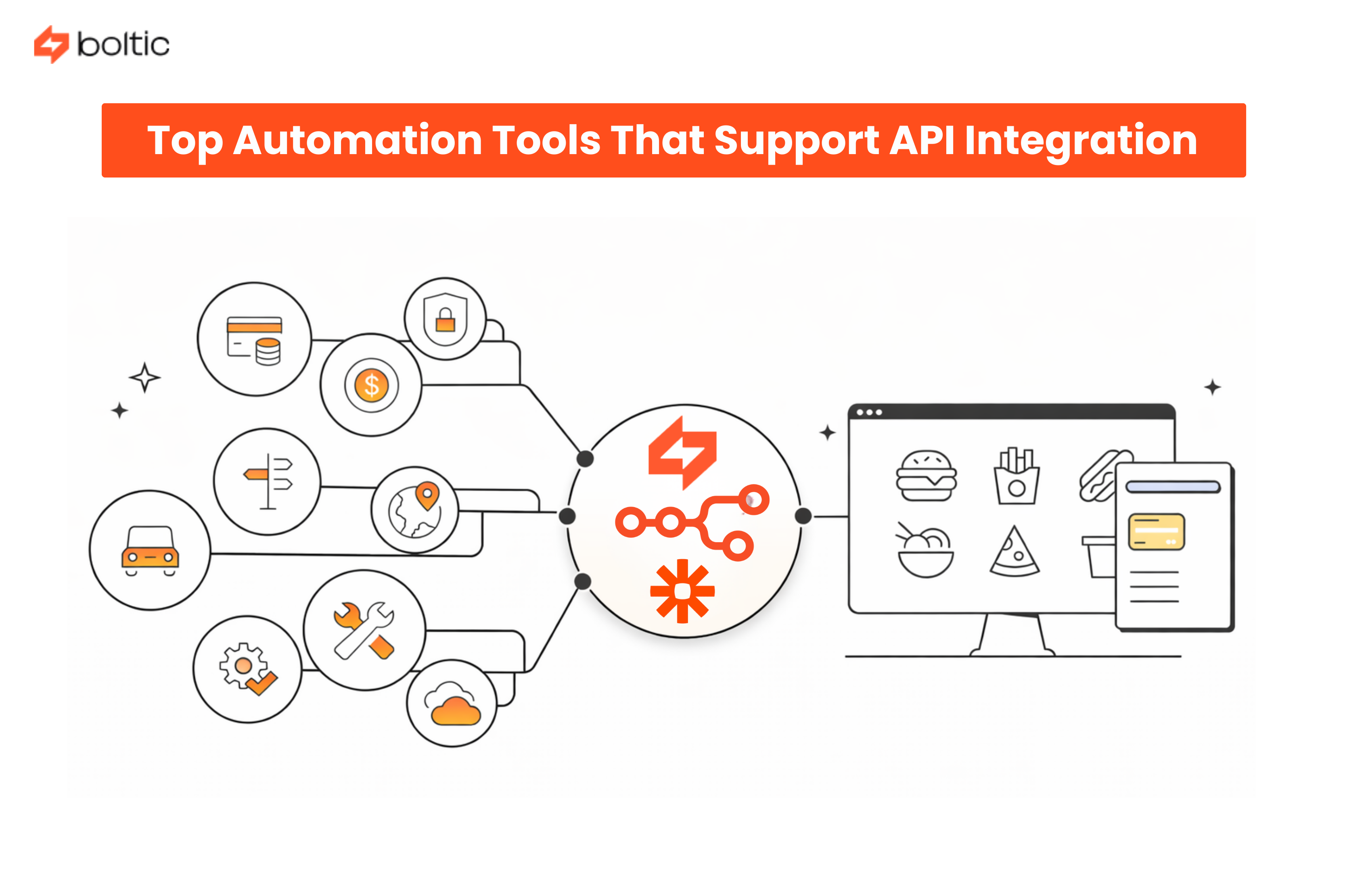
Top Automation Tools That Support API Integration
1. Boltic
An AI-powered platform that uses a no-code interface, Boltic enables your business to use third-party integrations for connecting various apps and services. Through its simple visual workflow builders, you can integrate one or more APIs to improve workflows and exchange credible information across channels. It enables your data teams to:
- Build custom workflows with API integrations suited to your business
- Fetch data from existing systems
- Share data with another system’s API in a secure manner
- Monitor and update data in real time
- Remove and manage data across multiple systems
With an efficient AI agent handling orchestration of the API as and when required, you can set your business up for success. Triggers can be set up to chain more than one API call and tackle errors or failures whenever they occur. Moreover, data teams are able to execute multiple data exchange tasks in a secure manner and boost their productivity.
2. Zapier
An automation tool that allows you to connect multiple web applications through API integration, Zapier is efficient and secure. Developers do not need to write code, and yet businesses are able to automate complex workflows. Zapier enables companies to:
- Set up base and operations in business quickly
- Detect triggers and automate smooth workflows
- Exchange data seamlessly across numerous applications and systems
Your data teams are empowered to scale through API integrations across more than 8000 platforms. It is big on efficiency and big on AI orchestration.
3. N8N
A low-code workflow automation tool, n8n enables businesses to create workflows and automate a wide range of data exchange tasks.
- Allows integration of custom APIs to support business operations
- Enables increased control over data through self-hosting
- Provides additional security and data protection
- Enables flexibility by allowing the incorporation of advanced codes
Used widely across industries, n8n is an automation tool you can opt for in case your developers are looking to customize code for your business needs.
Conclusion
As API integration grows more and more crucial for businesses, security remains a concern. With increased distribution of systems throughout the internet, data protection has grown into a challenge. Enhanced or zero-trust security has become the norm of the era. Authentication is a factor that businesses refuse to negotiate with, no matter how harmless a data request seems.
Moreover, as APIs evolve through AI integrations and become autonomous, API governance becomes imperative. Good policies and guidelines can help build a future that allows for the execution of safe and secure use of API through automated workflows. Drag and drop triggers/actions, and organize your apps and systems in one single place with Boltic’s automation features. Build smart AI-powered workflows that can handle numerous API calls through easy integrations and scale your business rapidly.
drives valuable insights
Organize your big data operations with a free forever plan
An agentic platform revolutionizing workflow management and automation through AI-driven solutions. It enables seamless tool integration, real-time decision-making, and enhanced productivity
Here’s what we do in the meeting:
- Experience Fynd Boltic's features firsthand.
- Learn how to automate your data workflows.
- Get answers to your specific questions.

.png)