
According to one of the latest eCommerce reports by Forbes, 91% of shoppers make purchases online. An ever-expanding, ever-changing digital universe of databases, sensors, customer interactions, and transactions persists in the backdrop, driving fundamental operations in eCommerce. Real-time data streaming performs an integral role here.
In contrast with batch processing, which leads to business delays, real-time data processing uses modern streaming architectures. Such system design allows for the smooth processing of high-volume data in motion and is crucial in actively delivering personalized customer experiences. Reliable and efficient data pipelines make lead management impactful, help drive conversions, aid in tracking inventory updates, and improve customer experience. This guide will delve deeper and explore the scope of dynamic data in eCommerce to assist you in implementing real-time data streaming for your business.
Use Cases of Real-Time Data Streaming in E-Commerce

Here’s how various B2B and omnichannel businesses apply real-time data streaming:
Dynamic Pricing
Real-time data streams are used to balance pricing in businesses, based on changing market conditions, inventory updates, behavior among competitors, and other time-sensitive issues. Revenue and profits, therefore, can be optimized through timely interventions.
Personalized Recommendation
Recommendation models adapt as customers browse through websites and preferences. These clickstream events are analyzed to understand behavior in real-time and are instrumental in providing pertinent product suggestions. Leads are nurtured adequately over different levels, and your business is able to make the best out of cross-sell opportunities.
Inventory Synchronization
Tracking inventory levels in real-time from various sources like warehouses, online channels, and retail stores has been made possible through data streaming. As a result, retailers are able to furnish credible stock updates to customers and prevent overselling. Moreover, reorders can be automated, and complete stockouts can also be avoided.
Detection of Fraud
Financial losses through fraudulent transactions can be effectively tackled through real-time data streaming. Before payment authorization completes, transaction patterns and user behavior are analyzed for consistency. In case of anomalies and inconsistencies, they are flagged or automatically blocked. Alerts are also sent to users, thus reducing potential damage to the brand’s reputation.
Order Tracking & Notifications
Real-time data streaming supports order tracking across the lifecycle of orders. Billings, shipping, payment, deliveries, and any additional supply chain operations trigger events. Customers are sent updates through different channels, while operational teams are able to retain complete visibility. It helps resolve delays or bottlenecks more quickly and aids in maintaining transparency with stakeholders.
Customer Behavior Analytics
High purchase intent, search queries, cart abandonment, and purchase-related issues can be tracked through continuous event streams and dashboards. Automated triggers can be configured to target and resolve such roadblocks and streamline customer journeys. Additionally, dynamic insights enable targeted planning for marketing campaigns and drive better decision-making during product development.
Understanding the Fundamentals of Real-Time Data Streaming
A grasp of the fundamentals can aid businesses in retaining their competitive edge in a world where access to data and efficient processing determines success.
EDA (Event-Driven Architecture)
Event: Any action/change that is of consequence to a business.
EDA, or Event-Driven Architecture, is an integration design that works by creating, detecting, or responding to events across distributed business systems as they occur. They allow for the free flow of information between apps and help complete tasks more quickly. This aids businesses in enhancing customer engagement and supporting agility in operational teams, making them more efficient.
A user action occurs → Event is created/published → Other systems/apps respond independently.
How Real-Time Data Processing Works:
Real-time data processing begins at an app or starting point and moves through an EDA, which can be simple or complex. Certain key components form a part of these software designs:
- Event Producer: Generate and publish raw streaming data to a topic (a unit of organization).
- Topic: Logical channels that help categorize similar events.
- Partitions: Streams/events that are split to improve scalability through parallel processing
- Event Broker: Distribute and feed topics to consumers
- Event Consumer: Software programs that deliver outputs and execute actions based on events they receive.
Streaming vs Traditional Batch Processing
Traditional batch processing works by accumulating a high volume of data and processing it in a batch within a time period. Dedicated personnel work to handle complications. However, activities like scheduling, triggering, and sharing updates require trained personnel, which can lead businesses to incur higher costs.
In contrast, streaming involves analyzing and organizing data in real time. This is particularly efficient for businesses where data volume is infinite and data is prone to dynamic changes. Stream processing uses EDAs to record events in real time and trigger instant responses, reducing latency and improving efficiency in big eCommerce organizations.
Latency Requirements
Latency is understood as the time involved in data generation and analysis. Low latency is characterized by quick transmission and rapid processing of data. In comparison, higher latency involves delays and slow data processing. A reliable and efficient data pipeline involves smooth extraction and movement of data across multiple systems.
- Fraud detection alerts and payment authorization require ultra-low latency
- Inventory management tasks require low to moderate latency
- Dynamic pricing requires low latency
- Reporting & analytics dashboards can work with moderate to high latency
In an industry where speed is central to success, low latency can empower businesses to make informed decisions and respond to dynamic markets.
What Constitutes The Streaming Technology Stack
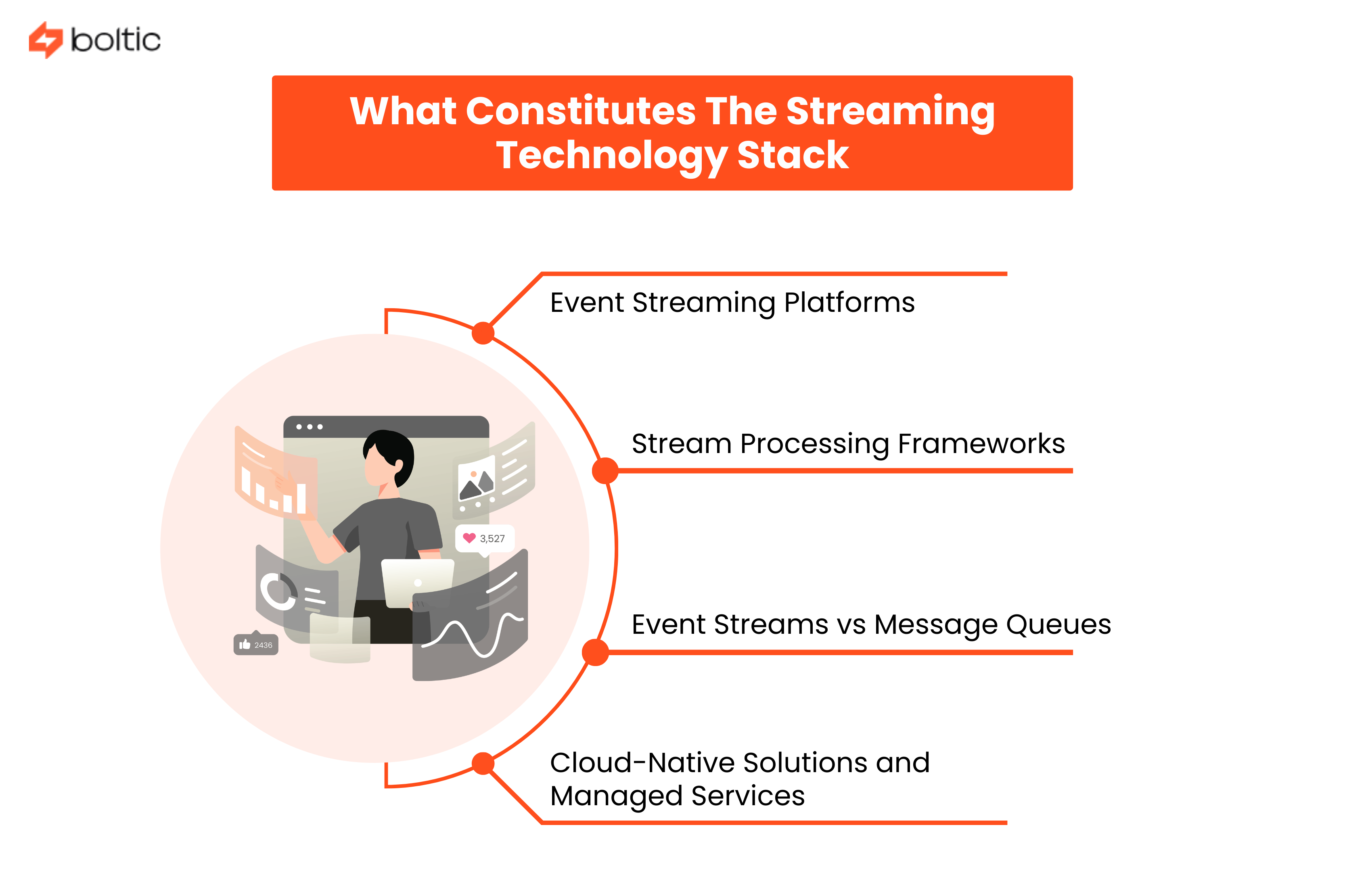
Data streaming technologies form the backbone of successful processing and transmission efforts.
Event Streaming Platforms
Event streaming platforms provide an architecture that helps capture, react, store, and process events as they occur. They work by moving through the sequence of events captured from databases, applications, and IoT sensors, and distribute them for processing. Top tools include:
1. Apache Kafka
An open-source event streaming platform used for streaming analytics, building reliable data pipelines, and data integration tasks.
- High fault tolerance and throughput
- Manages data pipelines in real time
- Integrates flexibly into stream processing frameworks
2. Apache Pulsar
A cloud-native streaming platform that was created by Yahoo!, Apache Pulsar is high-performing and can handle extensive real-time feeds. Whether it's messaging or event processing that your business is looking for, Pulsar ensures streamlined performance.
- High throughput and fault tolerance
- Supports multi-tenant architecture
- Is low latency and easy to use (flexible API)
- Comes with a built-in data management strategy like geo-replication
3. AWS Kinesis
Collecting, processing, and analyzing real-time data is made easier by the cloud-based streaming solutions of Amazon Kinesis. Continuous data flows are effectively processed and used to prompt triggers, update dashboards, or carry out other actions through seamless integration across the AWS ecosystem.
- High throughput and easy integration
- Real-time insights and dashboards
- Encryption and access control for data protection
Data-driven insights and smooth operational execution can help generate long-term returns among eCommerce businesses.
Stream Processing Frameworks
Stream processing frameworks work as systems that provide pipelines to handle data in real time. They accept inputs and process them through a series of triggers and actions to deliver results to customers and end receivers. These tools remove the need to develop data processing systems from scratch and allow developers to integrate functions from existing stream processing libraries.
1. Apache Flink
Apache Flink is an open-source system and a distributed framework designed to perform stateful computations on continuous data streams. It stands out because of:
- Stateful high fault-tolerant streaming.
- Has event-time processing and sophisticated windowing.
- Supports streaming and batch simultaneously.
- Combines with Kafka, HDFS, and third-party databases.
2. Spark Structured Streaming
Spark Structured Streaming is a fault-tolerant, scalable stream processing engine that is based on Spark SQL. It enables developers to use the same DataFrame and Dataset APIs for batch and streaming workloads to simplify development and avoid maintaining separate technology stacks.
- Synchronous API on batch and streaming.
- Checkpointing to provide fault tolerance.
- Permits complicated aggregations and windowing.
- Interoperates with cloud data warehouses and Delta Lake.
Event Streams vs Message Queues
Both message queues and event streams are capable of being used to facilitate asynchronous communication within a distributed system. But they differ in the way data is handled.
- Message queues: Message queues can be used in task scheduling, one-time delivery guarantees, and microservice decoupling.
- Event streams: Ideal in real-time analytics, audit logging, and high-throughput data pipelines.
In the case of e-commerce, message queues support sequential processing of work, such as order processing, and event streams, which support inventory synchronization, fraud detection, and scale-based customer behavior analytics.
Cloud-Native Solutions and Managed Services
Cloud providers provide fully managed streaming platforms that eliminate infrastructure overhead and scale automatically with demand, which is especially useful to e-commerce businesses that do not require management of clusters manually.
1. AWS MSK (Managed Streaming for Kafka)
An Amazon-managed Kafka service that deploys clusters, scales clusters, and maintains the clusters. It is natively integrated into the AWS ecosystem, which makes it an excellent fit when used by companies that already run on AWS.
- Availability zone auto-scaling with high availability.
- Intrinsic support of Lambda, S3, and Kinesis.
- Compliant encrypted data in transit and at rest.
2. Google Cloud Pub/Sub
A massively scalable serverless, globally distributed, high-throughput, low-latency event ingestion messaging service. It separates the event producers and consumers; hence, it can guarantee consistent delivery without regard to the speed of processing downstream.
- Processes millions of messages in a second all over the world.
- Scaling automatically and needs no infrastructure management.
- Connects to BigQuery, Dataflow, and Cloud Functions.
3. Azure Event Hubs
Azure Event Hubs is a Microsoft streaming platform that is available on the cloud and compatible with the Apache Kafka protocol, which allows the migration of Kafka-supported workloads. It serves high-volume event ingestion, and it has enterprise-grade security built in.
- Migration Kafka-friendly migration.
- Supports Azure Stream Analytics and Azure functions.
- Low latency, in-built horizontal scalability, and partitioning.
Design Patterns That Make or Break Your Streaming Architecture
Choosing a streaming technology is the easy part. Getting it into a structure that endures real-world chaos, oversells coming out of flash sales, schema modifications in the middle of deployment, and incidental events caused by legacy systems that weren't built for events, that is where most of the teams fail.
Event Sourcing
Event sourcing considers all changes of state as an immutable log but does not replace existing information. You record an InventoryReduced event, with a quantity of 1, instead of changing the number of an inventory count, which is 100, to 99.
You get complete audit trails, time-travel debugging, and the ability to rebuild any state by replaying events from scratch. When a client challenges a purchase, you are able to recreate all the steps within minutes.
CQRS (Command Query Responsibility Segregation)
CQRS splits your write and read models. Your checkout service publishes OrderPlaced events to Kafka. Your customer dashboard reads from a denormalized Postgres database optimized for fast queries. A streaming consumer keeps both synchronized in real-time. Each side is optimized independently; writes prioritize durability, reads prioritize speed.
CDC (Change Data Capture)
CDC is how you bring legacy databases into your streaming world without a full rewrite. Tools such as Debezium connect directly into your database transaction table and send all inserts, updates, and deletes as an event, requiring no change to your application code.
On architecture philosophy:
- Lambda architecture - runs batch and streaming pipelines in parallel, combines results at query time; powerful but operationally heavy
- Kappa architecture - eliminates the batch layer entirely, processes everything as a stream; simpler to maintain at scale
- Microservices communication - services emit events rather than calling each other directly, removing tight coupling that creates cascading failures
For most e-commerce teams, Kappa wins on simplicity. Your engineering team maintains one pipeline instead of two.
Real-Time Inventory: Building a System That Never Oversells
Your inventory system has one job: know exactly how many units exist, where they are, and whether they're available at all times, across every channel. Batch-updated databases fail this test the moment two customers try to buy your last unit simultaneously.
Real-time inventory streaming solves this by treating every stock movement as an event the instant it happens.
- A customer adds to the cart? InventoryReserved.
- A warehouse ships an order? StockDepleted.
- A return lands at the fulfillment center? InventoryRestocked.
Every system (your website, mobile app, retail POS, marketplace listings) consumes these events and stays synchronized without polling a central database every 30 seconds.
Stock level calculations and reservations work through optimistic concurrency rather than database locks. When a customer adds an item to their cart, a reservation event is published with a timeout (typically 15 minutes). A stream processor aggregates active reservations against available stock in real-time. No locks, no bottlenecks, just a continuously updated available-to-sell count.
Oversell prevention comes down to this logic:
- Available inventory = Total stock - Reserved inventory - Committed orders
- When available inventory hits zero, downstream systems receive an OutOfStock event immediately
- Reservation timeouts automatically release units back into available inventory when carts expire
Multi-warehouse coordination
Multi-warehouse coordination becomes manageable when all the locations publish on the same event stream. Your fulfillment routing logic subscribes to inventory events of every warehouse and reassigns orders to the best location, dynamically based on stock levels, proximity, and shipping costs, which are updated every minute.
Handling eventual consistency
Eventual consistency is the trade-off you accept. Distributed streaming systems don't guarantee every consumer sees updates at the exact same millisecond. Design your application to handle brief windows where counts may differ slightly across services, and real-time inventory monitoring will still reduce your stockout rate compared to batch-updated systems.
Dynamic Pricing Engine: React to the Market Before Your Competitors Do
When your inventory is streaming accurately, your pricing engine now possesses all that it requires to be intelligent. And with competitors revising the prices dozens of times a day, a system that recomputes overnight is virtually leaving money on the table.
A dynamic pricing engine listens to events instead of running on a timer:
- Demand signals: When a product's browse-to-cart ratio spikes, the engine triggers a price review within seconds
- Inventory velocity: When stock drops below a defined threshold, prices adjust upward automatically to protect the margin
- Competitor monitoring: Scheduled price scraping feeds into Kafka topics, triggering your pricing rules to respond before customers notice
The critical piece is A/B testing price changes before rolling them out fully. Route 10-20% of traffic to the adjusted price, measure conversion and revenue per visitor, and let data decide. This removes pricing decisions from gut instinct and puts them squarely in the hands of actual customer behavior.
Discount and promotion application
Discounts and promotions run through the same pipeline. When a flash sale or loyalty reward campaign goes live, the event fires and downstream systems apply the new price at checkout immediately, no manual intervention, no delays.
Cache invalidation strategies
Cache invalidation is where most pricing implementations quietly break down. Your CDN, query cache, and product pages can all serve stale prices for minutes after an update. Create a pipeline such that it produces cache-busting events whenever there is a change in price, so that customers always see the latest pricing.
Personalization That Knows What Customers Want Before They Do
Static recommendation engines show customers what other people bought last week. Real-time streaming shows them what they actually want right now based on what they've browsed in the last 90 seconds.
Clickstream data capture
The foundation is clickstream capture. Every page view, product hover, add-to-cart, and wishlist action is published as an event to your streaming platform. A stream processor enriches these raw signals with product metadata, customer history, and behavioral segments, making them immediately usable by your ML recommendation models.
That takes us to the next thing, real-time feature computation. Traditional ML pipelines compute features in nightly batch jobs. Streaming pipelines update them continuously, so when a customer browses three wireless headphones and adds one to their wishlist, your model's inputs reflect that intent within milliseconds, not after the next nightly run.
The session-based vs long-term tradeoff is worth thinking through deliberately:
- Session-based: responds to current browsing intent; best for homepage ordering, in-session cross-sells, and search ranking
- Long-term: incorporates purchase history and loyalty patterns; best for email recommendations and re-engagement campaigns.
Layer them rather than choosing one. A loyal customer who always buys formal wear but is browsing running shoes today should see running shoes, not suits. Session signals should override long-term predictions when the current intent is strong.
Freshness and computational cost
Balancing freshness against computational cost comes down to selective prioritization. Not every feature needs sub-second updates. Focus real-time computation on signals that directly change purchase intent, and let lower-impact features refresh every few minutes.
Order Processing Pipeline: Coordinating the Complexity
Modern order processing touches half a dozen systems simultaneously:
- Payment gateways
- Inventory
- Warehouse management
- Shipping providers
- Customer notifications
- Loyalty platforms
They all need to stay in sync within seconds. Without streaming, this coordination happens through synchronous API chains where one slow service delays everything downstream.
Streaming flips this model entirely. When a customer clicks "Place Order," your checkout service publishes a single OrderInitiated event, and its job is done. Every downstream system subscribes independently and acts in parallel.
Here's what that event cascade looks like in practice:
- OrderInitiated → Fraud scoring runs in parallel with payment authorization (under 500ms)
- PaymentAuthorized → Inventory reserves items; fulfillment routing assigns the optimal warehouse
- OrderConfirmed → Warehouse receives pick-and-pack instructions; customer receives confirmation
- OrderShipped → Real-time tracking events begin streaming to the customer dashboard, SMS, and email
Returns and cancellations follow the same pattern. A CancellationRequested event triggers inventory release, refund initiation, and notification, all in parallel, without a human manually coordinating between systems. If a payment processor experiences a latency spike, your order service remains unaffected. Events queue and process the moment responses arrive, so no order is silently dropped.
Boltic's pre-built integrations cut the overhead here significantly. Instead of writing custom webhook handlers for each service individually, Boltic's orchestration layer manages the connections and publishes normalized events your pipeline can consume immediately.
Fraud Detection: Stopping Bad Actors
The order processing pipeline moves fast. Fraud detection has to move faster.
By the time your fulfillment system is sending an order to a warehouse, your fraud scoring engine must have already cleared that transaction or put a red flag on it. That window is under 500 milliseconds. Miss it, and you are not shipping a product; you are chasing a refund.
The concept of real-time fraud detection involves grading each and every transaction on a set of signals at once.
For Example, Visa's AI fraud detection system produces a risk score from 0 to 99 by analyzing patterns of transactions, device fingerprints, behavioral biometrics, and geolocation, all in a few milliseconds. Here's how those scores translate into system actions:
Behavioral anomaly detection
This adds another layer. A customer who normally makes one purchase every two weeks, suddenly placing five orders in an hour, is worth flagging. Not declining automatically, but queuing for review.
The critical balancing act is minimizing false positives. Declining a legitimate customer mid-checkout damages trust more than any marketing campaign can repair.
Device fingerprinting and IP analysis
Device fingerprinting and IP analysis integrate directly into your streaming pipeline as enrichment steps. Each OrderInitiated event gets decorated with device metadata before fraud scoring begins. No extra latency, no separate lookup call.
Turning Customer Signals Into Revenue: Engagement Triggers That Act Fast
Every minute a customer goes without hearing from you after abandoning their cart is money walking out the door.
Abandoned cart detection and recovery
According to Klaviyo's abandoned cart benchmark report, the average conversion rate for abandoned cart email flows is 3.33%, with top 10% performers hitting 7.69%. That gap between average and top performers isn't product quality or pricing. It's almost entirely timing and personalization precision, both of which the streaming infrastructure directly controls.
When a customer abandons their cart, your streaming pipeline captures the CartAbandoned event the moment session activity drops. The clock starts. An automated workflow fires a recovery email within one hour. Studies consistently show this timing outperforms both "too soon" and "too late" windows.
But abandoned carts are only one trigger. A fully instrumented customer engagement layer responds to:
- Browse abandonment: customer viewed a product 3+ times without adding to cart; trigger a personalized browse-abandonment campaign
- Post-purchase follow-up: review request fires 7 days after delivery confirmation, cross-sell recommendation 14 days after
- Restock notifications: unlike wishlisted items, restock notifications are immediately sent out, and not on a nightly email digest.
- Personalized SMS/email timing: ML models learn each customer's peak engagement window and schedule sends accordingly, updated continuously from open and click events.
The compounding effect here is significant. Together, all these create a communication rhythm that feels personal rather than automated, because the signals driving each message are real-time behavioral data, not demographic segments updated weekly.
Data Integration Challenges That Many Face
Getting your streaming architecture to work in a controlled demo is one thing. Connecting it to a decade-old ERP, three payment gateways, and a Shopify store running custom plugins is another. Here's what you'll actually run into:
- Legacy systems weren't built to emit events. Use CDC tools like Debezium to tap database transaction logs and generate events without touching application code.
CDC from e-commerce platforms
- The formats of webhook and the schemes of authentication, as well as the structure of payload, vary in all forms of Shopify, Magento, and custom platforms.
- Normalize all into a common internal schema and then publish to Kafka topics. Downstream consumers will not be concerned with which storefront an order came from.
- Normalize all into a common internal schema and then publish to Kafka topics. Downstream consumers will not be concerned with which storefront an order came from.
Third-party service integration
- Shipping providers (third-party services), ERPs, payment gateways, and so forth, have API rate limits. Construct backpressure-aware adapter services, which do not hammer the API but gracefully reduce their consumption as it can.
Schema evolution
- Schema evolution is a long game. Use a schema registry from day one. Enforce backward-compatible changes. Add optional fields, never remove required ones, and version every schema explicitly.
Handling API limits
- API rate limits aren't edge cases; they're guaranteed to hit you. Design retry logic with exponential backoff and dead-letter queues for messages that fail after multiple attempts, so nothing silently disappears.
If It's Not Monitored, It's Not Running: Observability for Streaming Systems
Streaming systems fail quietly. A consumer crashes at 2 AM, lag builds silently, and by morning, your inventory counts are four hours stale. Nobody knows until customers start calling. Observability isn't optional; it's the difference between catching a failure in five minutes and discovering it via a support ticket.
The metrics that matter most:
- Consumer lag: the single most critical signal; set alerts the moment lag exceeds your per-use-case threshold (fraud detection: under 1 second; analytics: under 60 seconds)
- Throughput: track messages processed per second; sudden drops indicate consumer failures or upstream bottlenecks
- Error rates: high processing error rates signal schema mismatches, logic bugs, or downstream system outages
- Partition distribution: uneven distribution creates hot partitions that overwhelm individual consumers, while others sit idle.
Beyond technical health, build business KPI dashboards that tie stream performance to outcomes: inventory accuracy rates, fraud catch rates, cart recovery conversions. When consumer lag spikes, you need to immediately quantify the business impact. Not just the infrastructure alert.
Cost monitoring deserves equal attention. Over-retained data and over-provisioned partitions silently inflate cloud bills. Audit retention policies and partition counts quarterly. Set automated alerts for anomalies. Don't rely on your team to spot patterns in dashboards that they check twice a day.
Scaling for Flash Sales, Holidays, and Everything in Between
Your streaming architecture that handles a quiet Tuesday will buckle on Black Friday if you haven't designed for it. Scalability isn't something you retrofit after your first major outage; it's built in from the start.
The core rule: every component that processes events must scale horizontally, not vertically. Adding a bigger server has a ceiling. Adding more consumer instances doesn't.
What breaks under traffic spikes and how to prevent it:
- Hot partitions: poor partition key selection overloads a single partition while others sit idle; always use high-cardinality keys like order ID, never low-cardinality ones like country code.
- Consumer lag buildup: auto-scaling triggers must fire before lag becomes business-critical; test thresholds before peak season, not during.
- Database bottlenecks: streaming moves fast, but downstream databases need read replicas and connection pooling to absorb burst writes from consumers. For global operations, deploy clusters close to where events originate. Cross-region transfers compound latency and cost at scale.
Data retention
Data retention is a cost-compliance tradeoff. Clickstream data doesn't need 90-day retention. Order events may require 7 years for financial compliance. Set retention per topic, automate enforcement, and audit quarterly.
Load-test your full pipeline at 3-5× expected peak traffic before every major sale. No exceptions.
Your Streaming Implementation Roadmap: From First Event to Full Production
The teams that succeed with real-time streaming share one habit: they don't try to stream everything at once.
Begin with a use case with a clear and measurable ROI. The best starting points are always abandoned cart recovery, real-time inventory sync, and fraud detection since the before/after metrics are unambiguous. Pick one, define success criteria upfront, and resist scope creep mid-pilot.
Your pilot project checklist:
- Define the specific metric you're improving (stockout rate, recovery conversion, fraud loss)
- Set a baseline before any code is written
- Agree on a 60-90 day evaluation window with stakeholders
- Run streaming in parallel with existing batch systems before cutting over.
Incremental migration beats the big-bang rewrite every time. Move traffic gradually, 10%, then 25%, then 50%, until confidence is established. If something breaks, you have a fallback.
Another thing is organizational readiness, which matters as much as technical readiness. Streaming systems require new debugging skills and new alerting habits. Invest in training before the pilot, not after the first 3 AM incident.
Vendor vs build-your-own decision framework
Pre-build or your own framework? The question every team eventually faces. Building from scratch gives control but demands months of custom integration work. Managed platforms dramatically shorten time-to-value.
Boltic Pipes sits squarely in that middle ground, real-time data syncing across systems via automated pipelines, 100+ pre-built integrations, and automatic schema mapping, all without writing connector code. For most teams, this is a genuine lifesaver.
Wrapping Up: The Future of E-Commerce
Real-time streaming's ROI isn't abstract. It shows up in lower stockout rates, recovered abandoned carts, fraud caught before it clears, and recommendations that reflect what customers want right now. Measure it use case by use case (before and after), and the numbers speak for themselves.
The most common pitfalls aren't technical; they're:
- Scope creep during pilots,
- Skipping schema governance until a breaking change forces an emergency fix, and
- Treating streaming as a one-time project rather than a continuously evolving capability.
Avoid all three by starting narrow, measuring obsessively, and building feedback loops from day one.
As for what's next? Edge stream processing, AI-driven anomaly detection, and real-time ML inference at checkouts. The divide between teams that have streaming infrastructure and those that continue to have nightly batch jobs will only continue to expand.
Ready to stop running your e-commerce operations on yesterday's data? Boltic stands out because it brings together workflow automation, real-time data syncing, and 250+ templates, all under one platform, so you're not stitching together separate tools for every connection.
Teams get streaming use cases off the ground in weeks rather than quarters, without writing connector code from scratch or managing infrastructure they didn't sign up to maintain.
drives valuable insights
Organize your big data operations with a free forever plan
An agentic platform revolutionizing workflow management and automation through AI-driven solutions. It enables seamless tool integration, real-time decision-making, and enhanced productivity
Here’s what we do in the meeting:
- Experience Fynd Boltic's features firsthand.
- Learn how to automate your data workflows.
- Get answers to your specific questions.