




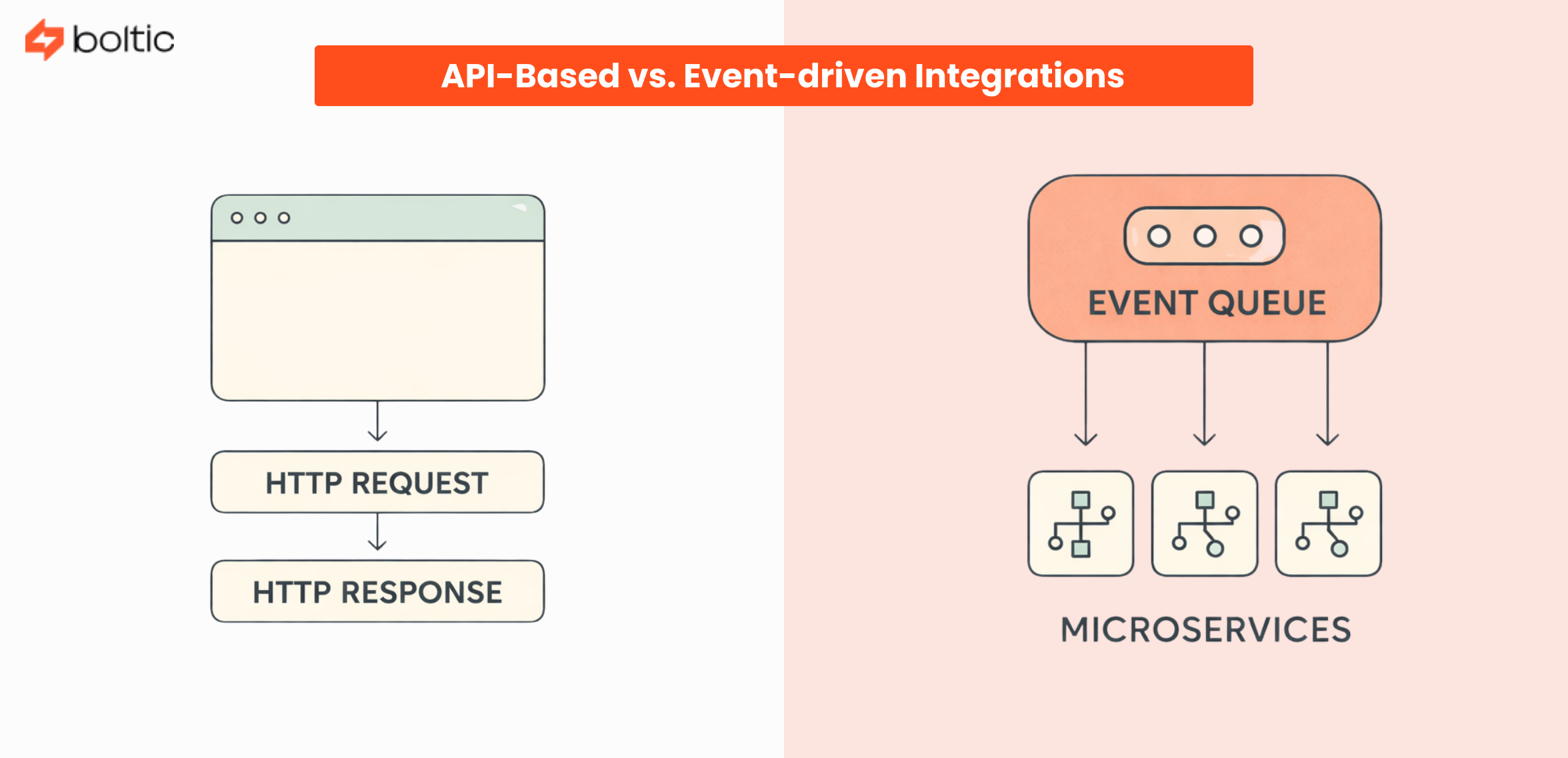


With the modern, fast-evolving digital world, the following question arises as an essential choice in linking software systems to businesses: do enterprises choose to lean towards the traditional API-based integrations or opt to use modern event-driven integrations?
This decision can essentially determine the data flow patterns of your organization, the speed of systems to respond, and how well-scaled the infrastructure becomes as your business expands.
It is important to know the architectural differences between these two in order to make wise decisions that resonate with the operational needs of your organization.
Understanding API-Based Integration Architecture
API-based integrations represent the foundational approach that most organizations started with. They are run on a simple request-response basis in which one system proactively requests another system to give information or take action.
- Imagine it as a telephone call: System A makes the phone call and requests an API endpoint of System B to accept the call, System B accepts the request and sends a response to System A.
How API-Based Integration Works?
When using a standard API-based integration, the requesting system needs to understand where to locate the receiving system and what form of data to send it. In many standard API-based integrations, the interaction is synchronous, meaning the requesting system waits for a response before proceeding. However, some API patterns also support asynchronous communication through callbacks or webhooks.
Such a point-to-point connection provides a clear flow of data, but at the same time, it provides tight coupling between systems. When the API of the receiving system is modified or is inaccessible (temporarily), the entire integration fails.
The core components of API-based integrations include:
- The client (request initiator),
- The API endpoint (service provider),
- The HTTP protocol (communication mechanism),
- Authentication and authorization mechanisms, and
- The response handler.
With Boltic's integration platform, you can manage API-based connections with ease and reduce deployment timelines.
When API-Based Integration Excels
API-based integrations are excellent in situations where real-time, on-demand communication is needed. The advantages include:
- Activating certain workflows on the user action.
- Reading, writing data where necessary.
- Integrations that need to be consistent and provide immediate feedback.
- Simple, straightforward platform-to-platform syncing
- Early-stage businesses with lower integration complexity
- CRUD operations across multiple systems
API-based integrations are commonly used by organizations that want to connect CRM systems with accounting platforms, automatically fetching customer or invoice data when required. These integrations provide predictability and fine-grained control over data exchanges.
The Limitations of API-Based Integration
API-based integrations can be problematic at scale. Polling and continuous checking of updates incur high costs and are inefficient.
When a system requires being aware of changes in another system, and is unable to receive push notifications, it must continuously ask, "Are there updates?" This consumes bandwidth, exhausts API rate limits, and increases latency.
Moreover, the close coupling implies that a change in the API of one system may propagate failures to other systems that rely on it. The lack of native support for real-time, push-based communication makes these architectures cumbersome for advanced automation scenarios. Most organizations find that their API-based integrations cannot perform well when they expand to hundreds of integration points.
Understanding Event-Driven Integration Architecture
Event-driven integrations invert the traditional model. Instead of System A asking System B for updates, System B announces when something important happens. Any system interested in that announcement can listen and react automatically.
This publish-subscribe pattern fundamentally changes how systems communicate and interact.
The Core Architecture of Event-Driven Integration
The architecture of event-driven integrations consists of three essential components:
- First - Lightweight integration components (often implemented as connectors, adapters, or microservices) are deployed close to source and target systems. These components capture changes, publish them as events, or consume events and deliver them to target systems.
- Second - Event brokers (or networks of brokers called event meshes) form the nervous system of the architecture. They receive published events, route them intelligently, and deliver them to all interested subscribers in a reliable, scalable manner.
- Third - Events are the fundamental units of communication. They are well-structured, defined representations of state transitions, being represented in standard forms, such as the AsyncAPI standard.
For example, when a customer places an order, the order management system publishes an "OrderCreated" event.
This single event might trigger any, many, or all of the following:
- Inventory reduction,
- Invoice generation,
- Shipping label creation, and
- Analytics updates
No system needs to know about the others; they simply react to the event. This is where Boltic's event streaming capabilities become particularly valuable, enabling organizations to manage complex multi-system workflows effortlessly.
Key Advantages of Event-Driven Architecture
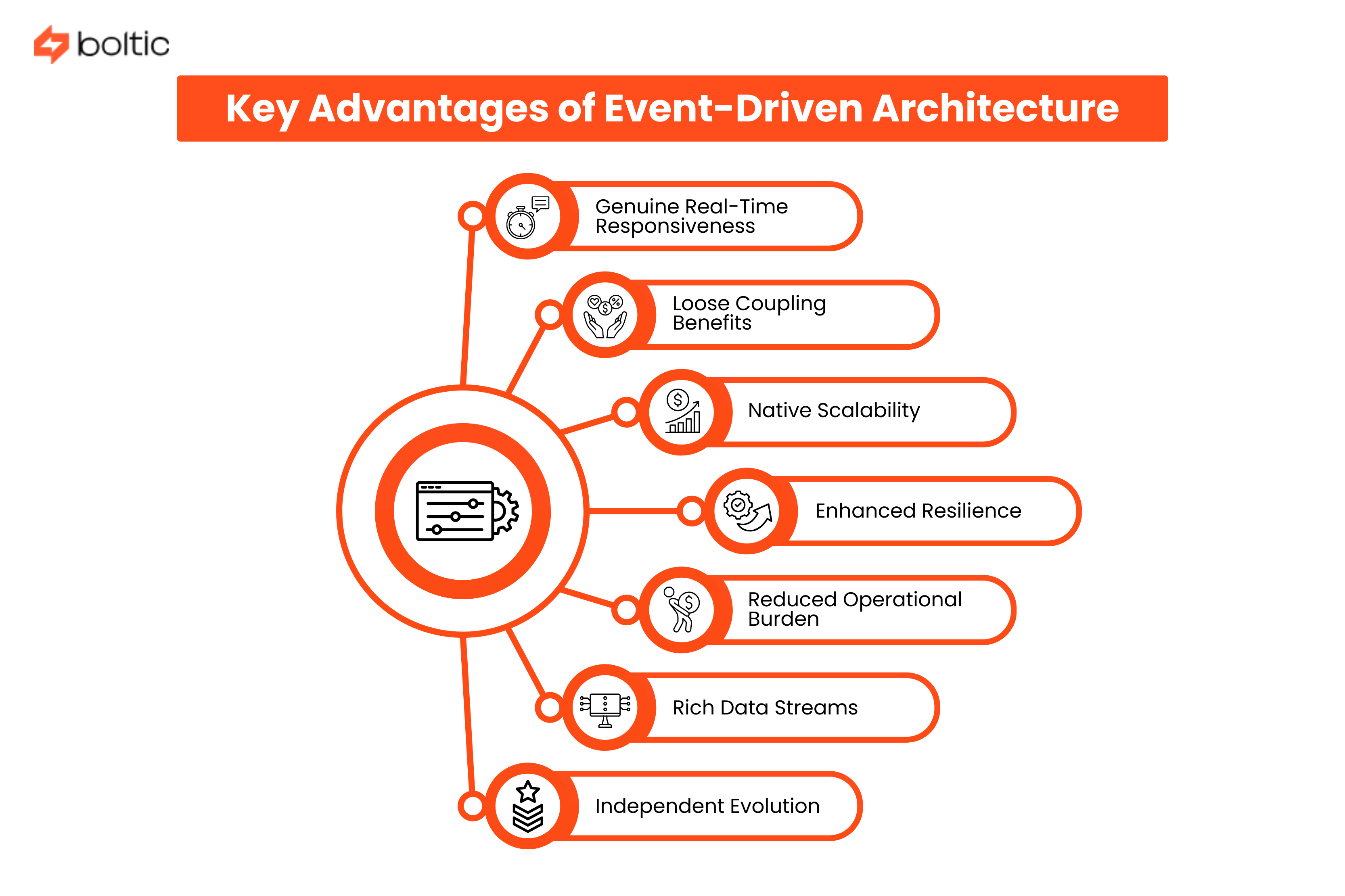
Event-driven integrations deliver significant operational benefits that address shortcomings in traditional API-based integrations. Here's what makes them powerful:
- Genuine Real-Time Responsiveness - The changes are immediately propagated to all concerned systems, eliminating the latency of polling that API-based integrations entail.
- Loose Coupling Benefits - Systems can evolve without the cascading failures that afflict tightly coupled API-based integrations.
- Native Scalability - Event brokers inherently deal with large amounts of data and spread processing amongst a set of subscribers.
- Enhanced Resilience - Message queuing and automatic retry mechanisms allow systems to process events asynchronously and recover from failures gracefully.
- Reduced Operational Burden - Old systems do not need continuous polling, and therefore, infrastructure does not have to strain like API-based integrations.
- Rich Data Streams - The history of events emerges as a useful source of analytics, machine learning, and compliance auditing.
- Independent Evolution - Ecosystems can have new systems without changing existing publishers or consumers.
The architectural beauty of event-driven integrations lies in the fact that they are able to manage one-to-many and many-to-many relationships naturally, unlike simple API-based integrations.
Challenges in Event-Driven Integration
The trade-off is complexity. Integrations based on events demand a more advanced infrastructure, event brokers, schemas, monitoring, and observability tools.
Event ordering and idempotency (preventing events from being processed more than once) require careful design-time consideration. Asynchronous flow debugging is more difficult than request-response cycle tracing in API-based integrations. Implementing and maintaining these systems requires more knowledge among teams.
Architectural Comparison: API-Based vs Event-Driven
Real-World Applications and Implementation Considerations
In reality, API-based integrations and event-driven integrations address various types of issues. We’ll discuss the performance of each of these approaches in practice and what that would mean for your architecture decisions.
Use Cases for Event-Driven Integrations
Event-based integrations are most suitable in situations in which large numbers of systems need to respond to the same change in near real time without overloading source applications:
- Notification and alerting systems - Email, SMS, and push notifications can subscribe to events and react instantly when thresholds are crossed, like “InventoryLow” or “High-RiskLogin”, without modifying the core transactional flows.
- Supply chain and logistics - As shipments move, each status change becomes an event. Warehouse systems, carrier integrations, and customer portals all consume these events independently, avoiding the tight coupling common in purely API-based integrations.
- IoT and sensor networks - Thousands of devices continuously emit telemetry. Event-driven integrations scale horizontally as event volume grows, whereas a request/response pattern would quickly hit throughput and cost limits.
- Fraud detection and risk scoring - Payment, login, and behavioral events flow into scoring engines in real time. Decisions can be made asynchronously, while the core applications remain decoupled and simpler.
Use Cases for API-Based Integrations
Even as event-driven patterns grow, API-based integrations remain critical wherever strong consistency, direct control, and explicit requests are required:
- Transactional systems of record - When creating or updating core records (customers, invoices, contracts), applications often rely on API-based integrations to ensure that operations succeed or fail explicitly, returning clear responses to the calling system.
- Regulated and audited workflows - Processes that are heavy on compliance (e.g., KYC, onboarding, approvals) are usually characterized by deterministic interactions, request logs, and synchronous confirmation. In this case, API-based integrations with contractual agreements are easier to control.
- Third-party SaaS integrations - Many external platforms still expose only REST/GraphQL APIs. Pulling data or pushing updates, such as sending leads to a CRM or invoices to an accounting system, typically relies on API-based integrations, coordinated by an integration hub like Boltic.
- User-triggered operations - When a user clicks “Generate report” or “Sync now,” the application uses API-based integrations to fire a direct call and show success or failure in the UI. Events can still be emitted in parallel, but the user-facing flow depends on the API response.
Conclusion: Building Your Integration Foundation
The choice between API-based integrations and event-driven integrations isn't binary; it's strategic.
- Simple and synchronous workflows in early-stage organizations can enjoy the simplicity and predictability of API-based integrations.
- As businesses grow, integrations become more complex, and real-time responsiveness turns into a competitive advantage, making event-driven integrations a necessity.
Ready to modernize your integration architecture? Boltic assists companies in creating and operating scalable AI integration workflows by integrating applications via APIs, webhooks, and automation events.Boltic also allows teams to have control over systems and enhances speed and flexibility across systems by having structured integrations and real-time, trigger-driven workflows. Interested? Reach out to us today!
drives valuable insights
Organize your big data operations with a free forever plan
An agentic platform revolutionizing workflow management and automation through AI-driven solutions. It enables seamless tool integration, real-time decision-making, and enhanced productivity
Here’s what we do in the meeting:
- Experience Fynd Boltic's features firsthand.
- Learn how to automate your data workflows.
- Get answers to your specific questions.


