
The online marketplace doesn't rest, nor do your customers. In an era where 90% of consumers rate an "immediate" response as essential to their customer service experience, the traditional 9-to-5 support model is obsolete. Enter ecommerce chatbots, the robots that never sleep. These digital assistants are not only responding to questions but are also reinventing online shopping as we know it.
Gone are the days of clunky, script-based bots that trapped users in a loop of "I didn't quite catch that." The current AI-based conversational agents are easy to use, very human, and can make sales like any human associate. With the growing competition among online retailers, the use of e-commerce chatbots is no longer a luxury but a strategic requirement of survival and growth.
This article examines how AI chatbots impact the retail world, the practical value that they offer, and how platforms like Boltic.io are making this technology accessible to businesses of all sizes.
Why Are Ecommerce Retail Chatbots Booming?
The use of AI in retail is taking a lightning-fast approach. As the world passes 2025, the statistics present a clear outline of a world that is more dependent on automation.
Key Industry Statistics (2024-2025):
Business efficiency and consumer demand are the two forces that are pushing towards automation. According to recent reports in the industry, there are some key trends:
- Market Growth: The chatbot market across the globe is estimated to be $9.56 billion by the year 2025, with a CAGR in excess of 23%.
- Volume of Transactions: E-commerce transactions through chatbots in 2024 reached up to $142 billion, which is gigantic compared to past years.
- Cost Efficiency: Businesses are anticipated to save nearly $8 billion annually by 2025 through chatbot-driven support automation.
These figures imply that ecommerce chatbots are not a transitory phenomenon but are already an essential part of the present retailing system. Now, let’s look at some major benefits of ecommerce retail chatbots for businesses.
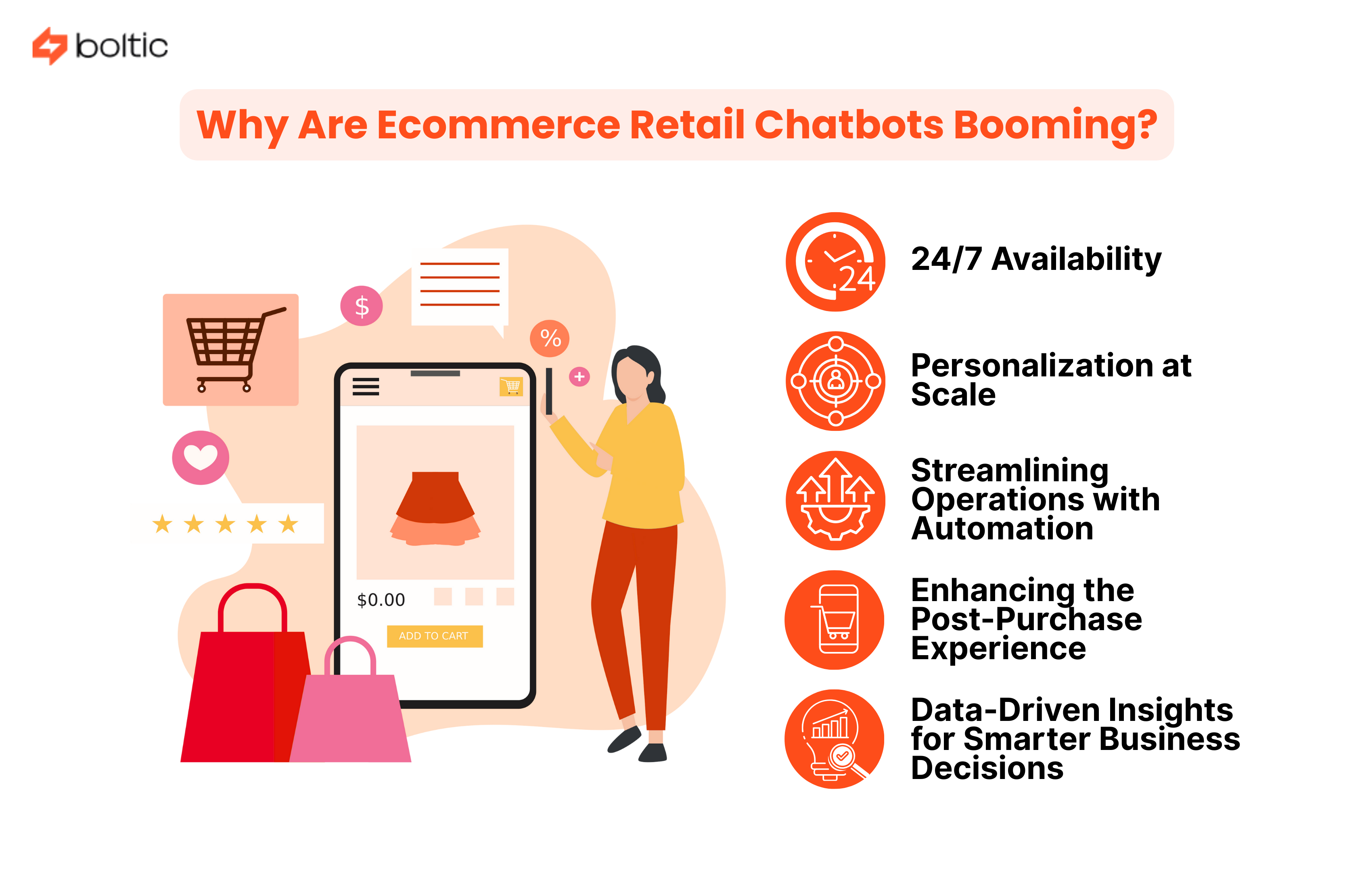
24/7 Availability: The New Standard For Customer Service
The immediate advantage of ecommerce chatbots is that they have around-the-clock support. Online shopping occurs 24/7; one of the customers can be searching for shoes at 2 AM or checking an order status during a lunch break.
Through E-commerce chatbots, retailers do not have to worry about any query remaining unanswered, no matter the time zone.
- Instant Gratification: Customers do not wait hours to get answers.
- International Reach: Provide service to international clients without having to staff night shifts.
- Peak Traffic Management: During events like Black Friday, bots handle thousands of simultaneous inquiries without breaking a sweat.
For Example: a customer visiting the site late at night to seek an explanation on the return policy should not be forced to wait to get a reply in the morning by email. The chatbot can give the policy details immediately and may even start the return process, leaving the customer satisfied and the workflow running.
Personalization At Scale: From Browsing to Buying
Modern ecommerce chatbots are driven by advanced Natural Language Processing (NLP) and Machine Learning (ML). This enables them to go well beyond the FAQs and become personalized shopping assistants.
Tailored Product Recommendations
Just as a professional in-store associate can observe a shopper’s preferences and recommend related products, AI bots can examine browsing history and past purchases to provide appropriate suggestions. In ways like:
- Cross-Selling: "I see you're looking at that camera. Would you like to see compatible lenses?"
- Upselling: Recommending a better version of a product with more value.
- Cart Recovery: Nudging customers of low inventory, offering them a personalized discount, or reminding them that they have items in their cart.
Standard Bots vs. AI Ecommerce Retail Chatbots: The Difference
The table below shows key differences between standard and AI-driven chatbots.
By delivering this level of personalization, ecommerce chatbots significantly increase conversion rates, potentially turning casual browsers into loyal buyers.
Streamlining Operations With Automation
The advantages to the retailers in the back-end of operations are just as deep as the advantages to the customers on the front-end. Ecommerce chatbots act as the first line of defense, filtering out noise and handling repetitive tasks.
Automating The Mundane
Tier-1 queries are easy, repetitive, and don't require critical thinking. Still, support teams are usually bogged down by them.
- "Where is my order?" (WISMO)
- "What is your refund policy?"
- "Do you ship to Canada?"
By letting AI ecommerce retail chatbots deal with these queries, human agents can concentrate on high-value interactions, e.g., dealing with a complex complaint.
The Boltic.io Advantage
This is where platforms like Boltic.io shine. Boltic enables retailers to create their own automated e-commerce workflow without a single line of code. As an example, a retailer could set up a workflow where:
A customer asks for an order update.
- The bot initiates a Boltic workflow to retrieve real-time information from the logistics provider.
- The status is instantly relayed to the customer.
- If the order is delayed, the system automatically issues a small apology or a discount code.
This smooth combination of information and activity is what distinguishes today's automation from plain auto-responders.
Enhancing The Post-Purchase Experience
Returns are a pain point for both customers and retailers. Ecommerce retail chatbots can simplify this by:
- Verifying eligibility instantly based on purchase date.
- Auto-generation of return shipping labels.
- Collecting feedback regarding why the item was sent back.
Ecommerce chatbots can also send shipping progress updates via messaging apps rather than waiting for a customer to request them. For example: "Your package has just arrived at your local facility!" which helps in building trust.
Data-Driven Insights for Smarter Business Decisions
Every interaction of a customer with a chatbot is a piece of data. Over time, this accumulates into a goldmine of actionable insights. Ecommerce retail chatbots have the capacity to study thousands of conversations to determine the trends that human agents may not see:
- Product Issues: A sharp rise in the number of inquiries regarding a certain shoe size could be a sign of a production inconsistency.
- Missing Inventory: A common search for a product that you don't stock is an indication of a missed revenue opportunity.
- Sentiment Analysis: AI can gauge customer mood, alerting managers if overall satisfaction starts to dip.
Overcoming Implementation Challenges
Irrespective of the above advantages, not all retailers are ready to implement the use of ecommerce chatbots because of their perceived complexity. Common concerns include:
- Difficulty of integration,
- Fear of losing the "human touch", or
- Technical skills are required to maintain the system.
No-Code Solutions
Luckily, the entry barrier has been reduced greatly. There is no longer a necessity for a group of developers to roll out an advanced bot.
- Visual Builders: Tools that use drag-and-drop interfaces to design conversation flows.
- Pre-Built Templates: Retail-specific templates that include pre-built intent libraries (e.g., "Track Order", "Return Item").
Boltic.io exemplifies this shift towards accessibility. Boltic eliminates the headache by allowing a visual interface to connect the tools already in use by a team (such as Shopify, Zendesk, or Slack). The retailer can begin with basic order tracking automation and then increase the functionality added to bots as they become more familiar with them.
The Future of Ecommerce Chatbots
As we look towards 2026 and beyond, ecommerce retail chatbots will be even more indistinguishable from human assistants.
- Voice Commerce: Voice-activated bots will enable people to shop hands-free.
- Visual Search: This will allow customers to select a photo of a product, and the bot will locate similar items in stock.
- Emotional Intelligence: Future bots will be more effective at detecting frustration, sarcasm, etc., and alter the tone to de-escalate the situation.
Bots are already becoming more conversational and less robotic through the integration of Generative AI (the same technology behind ChatGPT). The interactions are now fluid and natural because they are able to produce unique responses instead of sourcing a response from a published list.
Conclusion
The business world of retail is changing, and the ecommerce chatbots are leading this change. They offer a "win-win-win" scenario:
- Customers benefit from instant, customized support.
- Support staff are no longer obliged to endure the same amount of tedious work, and
- Businesses have reduced costs and increased conversion rates.
Boutique brand or a large marketplace? It is not whether you should use a chatbot anymore, but how quickly you can deploy one. By leveraging accessible automation platforms like Boltic.io, retailers can deploy intelligent, data-driven bots that not only solve problems but also actively contribute to the bottom line.
Ready to Transform Your Customer Experience?
The future of shopping is here. Is your business ready to talk? Don't have outdated workflows drag down your retail business. Explore how Boltic.io can help you automate support, streamline operations, and delight your customers with the power of no-code AI.
drives valuable insights
Organize your big data operations with a free forever plan
An agentic platform revolutionizing workflow management and automation through AI-driven solutions. It enables seamless tool integration, real-time decision-making, and enhanced productivity
Here’s what we do in the meeting:
- Experience Fynd Boltic's features firsthand.
- Learn how to automate your data workflows.
- Get answers to your specific questions.