







B2B revenue teams are dealing with challenging circumstances more than ever. Customers are finding businesses through different ways, sales cycles are getting longer, and buyers want quick responses and more personalised experiences. Each department-marketing, sales, customer success and finance- has its own systems, metrics and goals. Yet management expects that all of this will lead to steady growth and accurate revenue forecasts. Many problems with revenue start when there is a gap between how teams work and what the business needs. This is a situation where AI workflow automation for B2B revenue operations is getting more and more attention.
By taking care of simple tasks like sending emails or updating records, traditional automation helps teams get things done faster. AI-powered workflow automation takes it even further. It helps revenue teams figure out what to work on, spot risks early, and do optimal tasks at the right time throughout the go-to-market process. It's not just about saving time for RevOps leaders, sales ops, marketing ops and customer success teams. It's about making complicated systems easier to understand and making revenue outcomes more predictable.
This playbook gives practical examples of AI workflow automation. In the following article, we will talk about what AI workflow automation means for B2B revenue operations. It talks about how AI fits into the whole revenue cycle, from getting leads to renewing them, which workflows are the most useful, what data and tools are needed, how to measure real impact and how teams can use AI step by step without taking too many risks.
What Is AI Workflow Automation in Revenue Operations?
AI workflow automation in revenue operations means using machine learning models, large language models (LLMs) and rules-based logic that are built into workflow engines to automate both decisions and actions throughout the revenue funnel.
In a typical RevOps setup, automation is usually based on rules. For instance, if a lead fills out a form, give it to a salesperson. Send a follow-up email if a deal gets to a certain point. These workflows are helpful, but not very. They comply with orders without knowing what they mean or what will happen.
AI workflow automation takes things a step further. It looks at past and present GTM data, finds patterns, makes predictions about what will happen next, and then takes action based on what is most likely to happen instead of following set rules. The system doesn't just follow steps; it also looks at questions like which leads are most likely to convert, which deals are at risk, or which customers are likely to leave or grow.
This difference is important. Legacy RevOps automation makes processes more efficient, while the main goal of AI in RevOps is to improve the quality of decisions. The result is a revenue system that works more efficiently and makes better decisions over time.
How Does AI Workflow Automation Help RevOps Teams?
At a practical level, AI workflow automation helps RevOps teams identify the most meaningful insights instead of chasing every data point.
- First, it makes it easier to set priorities. AI looks at GTM data from marketing, sales and customer success to figure out where teams should spend their time and attention. Reps spend less time chasing low-quality leads or deals that aren't going anywhere and more time working on deals that are most likely to close.
- Second, it cuts down on operational drag. Some of the most time-consuming aspects of RevOps work are Data cleanup, CRM enrichment, reporting and manual handoffs. AI-powered workflows automate much of this background work, freeing up operations teams to work on system design, governance and optimisation.
- Third, it makes it easier to predict the revenue predictability. AI keeps an eye on pipeline movement, buyer behaviour, and customer signals all the time, identifying risks and updating forecasts as factors change. This leads to fewer surprises at quarter-end and greater confidence in revenue planning.
End-to-End B2B Revenue Workflow Map (Lead to Renewal)

To see where AI workflow automation fits, it's helpful to look at the whole B2B revenue cycle.
A standard B2B revenue workflow usually has the following steps:
- Lead capture,
- Qualification,
- Opportunity creation,
- Closing,
- Onboarding,
- Adoption,
- Renewal,
- Expansion and
- Revenue recognition.
AI automation can step in at any point to make data flow better, how decisions are made and how actions are triggered.
1. Top-of-Funnel and Lead Management Workflows
At the top of the funnel, speed and accuracy are important. AI-powered lead management workflows make sure that the right leads get to the right people at the right time.
When a lead enters the system, AI can automatically add firmographic and technographic data to it, which cuts down on the need for manual research. It can figure out if a lead fits the ideal customer profile, look for intent signals based on behaviour and content engagement, and match leads to existing accounts in complicated B2B settings. AI-driven lead scoring and routing don't use static lead scores. Instead, they keep changing priorities based on new signals. SLA monitoring workflows make sure that follow-up happens quickly and routing logic changes based on workload, expertise and the chance of conversion. The result is a top-of-funnel engine that works best for quality and responsiveness, not just volume.
2. Pipeline and Deal Management Workflows
Once opportunities are in the pipeline, AI workflow automation helps teams maintain momentum and visibility. AI keeps an eye on the progress of deals and spots ones that unexpectedly stall or go backwards. It picks up on risk signals like a drop in engagement, the loss of important stakeholders or a shift in buyer sentiment. These signals set off alerts and suggested next steps that help reps step in before deals get too far gone to be saved.
AI gives managers a better picture of the health of the pipeline by showing systemic problems instead of just a few isolated stories. Instead of just relying on updates from sales reps, leadership gets data-driven information about where deals are likely to close and where help is needed.
3. Post-Sale, Renewal, and Expansion Workflows
After the deal is done, AI automation gets even more powerful. During onboarding, workflows can be automatically changed based on the type of customer, the size of the deal and product mix. Adoption campaigns powered by AI keep an eye on usage and engagement patterns to find customers who need additional support.
Renewal risk workflows find early signs of churn, like fewer people using the service, unresolved support tickets or less engagement from stakeholders. At the same time, expansion workflows find accounts that are likely to expand, which leads to proactive outreach from customer success or account teams. This method changes customer success from reactive support to proactive revenue growth.
4. Revenue and Billing Operations Workflows
AI automation also helps with revenue operations that happen after the sale. AI can look at billing data to find problems, flag unusual changes to subscriptions and set up automatic approval workflows. In more complicated situations, AI helps with recognising revenue by finding differences between contracts, usage and invoices. These workflows help make financial reports more accurate, reduce revenue loss and make sure that rules are followed.
AI Workflow Automation Library for RevOps and Sales Ops
AI workflow automation covers the whole GTM engine, but some workflows always have a bigger effect than others. You can think of them in a simple way:
Trigger → AI Action → Automated Follow-Up
What are some examples of AI workflows for RevOps?
Common high-impact examples include:
- AI-powered lead scoring and routing
- Pipeline risk alerts and deal health monitoring
- Data hygiene and Automated CRM enrichment
- Sales and revenue predictions based on AI
- Renewal risk monitoring and expansion opportunity detection
AI Workflows for Scoring, Routing and Prioritising Leads
The first step in AI for sales ops is to set priorities. AI doesn't assign leads based on set thresholds. Instead, it looks at intent signals, account fit, past outcomes and engagement patterns to figure out how likely each lead is to convert. Routing workflows make sure that leads go to the right owner, and rep queues automatically change their order based on how likely they are to close. This helps sales teams stay focused on the most important tasks at any given time.
AI Workflows for Managing Pipelines and Making Predictions
Pipeline workflows put in changes from different deals, find new risk signals and constantly update forecasts. AI tells managers and reps what to do when patterns change, like getting stakeholders involved again or changing the close dates. These workflows make predictions more accurate and less reliant on subjective judgment, which makes revenue prediction more reliable.
AI Workflows for Data Hygiene and CRM Enrichment
Data quality is always a problem for RevOps. AI-powered data hygiene workflows automatically fill in missing fields, make sure values are the same, combine duplicates and keep records up to date across systems. CRM data is always accessible, so instead of performing cleanup projects every once in a while, it makes downstream workflows and reports more reliable.
AI Workflows for Sales Ops Administration
AI automation also helps with sales operations tasks like managing territories, setting quotas and handling compensation. AI can find mistakes in commission calculations, check changes to territories and point out problems before they affect payments or morale. This lowers risk and gives sales operations teams more time to do other things.
B2B Workflow Automation Beyond Sales: Marketing, CS, and RevOps Ops
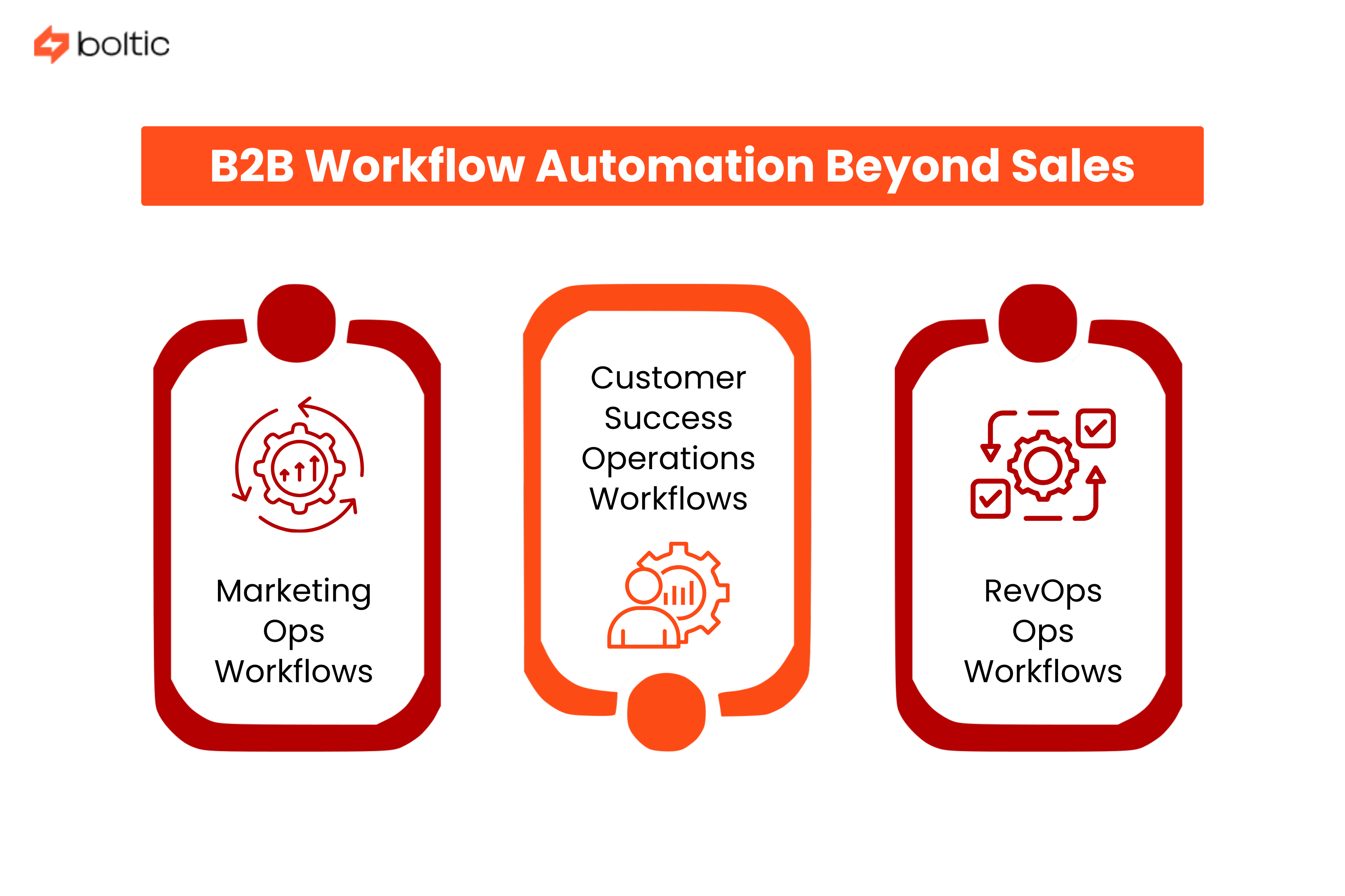
People often make the mistake of thinking that AI workflow automation is only for sales when they talk about it. Revenue operations exist because revenue is generated and maintained by various teams, not solely by sales representatives finalising transactions. The best use of AI workflow automation is when it is used throughout the entire go-to-market engine, which includes marketing operations, customer success operations and internal RevOps functions.
Even the best sales automation doesn't work well when these teams use different workflows and metrics. When AI-driven workflows are aligned, revenue execution gets faster, more organised, and more predictable. This part looks at how AI workflow automation can be used in more than just sales and why B2B companies need to use it across all departments.
1. Marketing Ops Workflows (Campaign, Attribution, and MQL Management)
Marketing operations are at the very beginning of the revenue lifecycle, but they often have the same problems: they focus too much on volume over quality, have different definitions of qualified leads and can't see how their work affects revenue downstream.
AI workflow automation helps marketing operations go from activity-based execution to optimising based on results.
AI-driven lead qualification is one of the most useful uses of AI. AI doesn't just look at static MQL rules; it also looks at behavioural signals, firmographic data and past conversion patterns to figure out which leads are genuinely sales-ready. This makes things easier between marketing and sales because there are fewer low-intent leads that are passed on.
AI also makes it easier to optimise campaigns. AI workflows can change the mix of channels, budgets and targeting dynamically by looking at performance across channels and linking engagement data to pipeline and revenue outcomes. This lets marketing ops teams focus on metrics that are important for revenue, not just surface-level ones like clicks or form fills.
Attribution workflows also get better. AI can connect multi-touch journeys and show patterns that show which campaigns consistently lead to closed deals. This makes it easier to make decisions about how to spend money and plan for the future.
Finally, you can automate changes to list hygiene and scoring. AI constantly cleans up contact data, changes scores based on new signals, and makes sure that segmentation remains accurate as buyer behaviour changes.
When marketing ops teams work together on these workflows, they can better align with revenue outcomes instead of working alone.
2. Customer Success Operations Workflows
In B2B companies, sales don't stop when a deal is done. Retention, renewals and expansion are often the main drivers of long-term growth. Customer success operations are very important here, and AI workflow automation helps them go from reactive to proactive engagement.
One of the most popular workflows is health scoring based on AI. AI uses product usage data, support interactions, engagement signals and billing behaviour to create dynamic customer health scores, so you don't have to rely on manual checklists or subjective assessments. These scores change all the time as new information comes in.
This is the basis for churn risk detection. AI finds early warning signs like a drop in usage, unresolved support issues, less engagement from stakeholders, or changes in how contracts are handled. When risk levels go above a certain point, automated workflows send out alerts or playbooks that tell customer success managers to reach out right away.
AI is also helpful for workflows that help businesses grow and sell more. AI can find customers who are suitable candidates for more products and higher tiers by looking at how they use the products and comparing them to other customers. These insights help customer success teams figure out which accounts are most likely to have successful growth conversations.
You can also automatically customise onboarding workflows. AI customises onboarding tasks and messages based on the type of customer, the complexity of the deal and the expected time to value. This makes it easier for customers to use the product and keep it for a long time.
AI workflow automation helps customer success operations by allowing earlier intervention, better prioritisation, and more consistent execution. All of these factors have a direct effect on revenue stability.
3. RevOps Ops Workflows (Data, Documentation, and Enablement)
Revenue operations itself often has to do a lot of internal work that is necessary but takes a lot of time. Even though they don't directly make revenue, reporting, documentation, enablement and cross-functional communication use up a lot of bandwidth. AI workflow automation can help a lot with this problem.
One common use case is managing dashboards and automated reporting. Without any help from people, AI workflows can update dashboards, look for unusual patterns and summarise important trends. RevOps leaders don't have to spend hours putting together reports. Instead, they get synthesised insights that show what's changed and why it matters.
Another area that is affected is enablement and documentation workflows. Large language models can help you write, change and share playbooks, process documentation and internal rules when workflows or tools change. This makes things more consistent and lowers the chance that teams will share old information.
AI can also help with quarterly business reviews (QBRs) and updates for executives. AI can summarise how well things are going at each stage of the funnel, find the most important factors and write first drafts of stories that RevOps leaders can improve. This changes the focus from collecting data to figuring out what it means for the future.
Lastly, AI workflows help keep things in sync within the company. RevOps teams can find systemic problems sooner and coordinate responses better by bringing together insights from marketing, sales and customer success in a shared operational context.
These internal processes may not be visible to the general public, but they are necessary for increasing revenue operations without hiring more people.
Data Foundations for Revenue Operations AI Automation
AI workflows are only as effective as the data behind them. It's important to have strong data foundations.
What Data Do You Need for AI in RevOps?
For AI to work well in RevOps, it needs at least:
- Information about accounts and contacts
- Data on activity and engagement
- Data on how products are used
- Data about contracts and billing
- Customer service and support interactions
It's more important to be complete and consistent than to have a lot of details. Even the most advanced AI workflows don't work well with data that is fragmented or unreliable.
Core GTM Data Model and Integrations
A good RevOps data stack links CRM, marketing automation tools, customer success tools, product usage tracking, billing systems and, if possible, a central data warehouse. The goal is to have a single view of the customer's journey from lead to renewal.
Data quality, governance and AI readiness checklist
Before expanding AI workflows, RevOps teams should make sure that data ownership is clear, fields are standardised, lifecycle stages are documented, and integrations are reliable. Governance and hygiene are things that need to be done before anything else.
Tools and Platforms for Revenue Operations AI Automation
Rather than focusing on individual tools, it is more useful to understand the roles tools play.
What Are the Best AI Tools for RevOps and Sales Ops?
AI-enabled CRMs, workflow automation platforms, revenue intelligence and forecasting tools, CPQ and billing systems and conversational AI are all common types of AI tools. The right choice depends on how ready the organisation is, how mature the data is and how workflows work.
Tool Categories and How They Fit Together
Most RevOps stacks have a system of record, an orchestration layer and an intelligence layer. Teams can build architectures that can grow and change by knowing how these things work together.
Evaluation Checklist for RevOps AI Vendors
Some important factors are workflow coverage, integrations, data control, explainability, ease of use for administrators, security and clear pricing.
Measuring Impact and ROI of RevOps AI Automation
Not technology failure, but measurement failure is one of the most common reasons AI projects in revenue operations lose steam. Teams start using AI workflows and see some early improvements, but they have a hard time measuring the impact in a way that makes sense to leaders, finance, or cross-functional stakeholders.
You need to change the way you think in order to figure out the ROI of RevOps AI automation. AI shouldn't be looked at as a separate skill. Instead, its effects should be looked at on the level of the workflow, where changes in behaviour, efficiency and results can be seen and measured.
This part explains how B2B revenue teams can create useful measurement frameworks that connect AI-driven workflows to business outcomes.
How Do You Measure ROI of AI in RevOps?
The best way to figure out ROI is to link each AI workflow to specific operational and revenue results. Instead of asking if "AI is working," RevOps leaders should ask if a certain workflow is making measurable improvements over a baseline.
There are three primary categories of impact to track.
- The first thing is how well it works. AI workflows often cut down on the time it takes to do things by hand, like entering data, qualifying leads, making reports and reviewing pipelines. A clear and relatable way to show value is to measure how much time each rep or ops team saves. These gains mean more time to sell and lower costs of doing business.
- The second group is about how well something works. AI makes decisions better, which shows up in metrics like higher conversion rates, shorter sales cycles, better win rates and better outcomes for renewals. These signs show that teams are not only working faster but also making better decisions.
- The third category is predictability. Better forecasting and less variation are two of the most strategic benefits of AI in RevOps. Leaders can see how AI helps make revenue planning more accurate by looking at changes in forecast accuracy, pipeline coverage and late-stage deal slippage.
When these improvements are linked to specific workflows instead of being added up into one big number, ROI becomes more interesting.
Key KPIs for AI Workflow Automation Across the Funnel
Different stages of the revenue lifecycle need different ways to measure success. This is true for a strong measurement framework.
- MQL-to-SQL conversion rates, lead response time and the percentage of sales-accepted leads that turn into opportunities are all important KPIs at the top of the funnel. Improvements here show that AI-driven scoring and routing workflows are making leads better and faster.
- Win rate, deal velocity, stage duration and pipeline coverage are all important metrics in the sales pipeline. AI workflows that find risks and suggest what to do next should help close rates go up over time and stop things from getting stuck.
- Key metrics include the renewal rate, churn rate, expansion ARR and time to value after the sale. AI-driven health scoring and expansion workflows should help you get in touch with customers sooner and help your existing accounts grow more steadily.
- Forecast accuracy and variance are general signs of system health at all stages. A lower forecast error means that data, decision-making and execution are better aligned.
- RevOps teams can show that AI workflows have an effect by tracking these KPIs before and after they are put in place.
Designing Pilots and Experiments That Prove Value
For a lot of companies, the best way to adopt AI is to do focused pilots instead of broad rollouts. Well-planned pilots lower the risk to the organisation and make it easier to measure ROI.
- The first step is to choose workflows that have clear owners and outcomes that can be measured. Lead prioritisation, data hygiene, or pipeline risk detection are often good places to start because they have an impact on daily operations and show results quickly.
- Next, teams should set up baseline measurements. Before adding AI, you need to write down how well things are going right now, like the average lead response time, conversion rates, or forecast accuracy. Without a baseline, claims of improvement are just stories.
- During the pilot, RevOps teams can use phased rollouts or controlled comparisons to figure out what effect something has. One region or segment, for instance, might use AI-driven workflows, while another keeps doing things the way they have always done. When you compare results, it's easier to establish that AI is the cause of the changes.
- Communication is just as important. Pilot results should be shared with stakeholders in clear and business-oriented language that shows both quantitative gains and qualitative improvements, like less friction or more confidence.
- Successful pilots build internal momentum, which makes it easier to get more people to use them and invest in them.
Translating Operational Gains Into Business Value
One problem that RevOps teams often have is figuring out how to turn operational improvements into money. Not every benefit can or should be measured in terms of revenue, but linking metrics to business outcomes makes them more credible.
For instance, saving time for each rep can mean they can sell more. You can use the average deal size to figure out how changes in win rate or cycle length will affect revenue. Lower churn and higher expansion rates have a direct effect on lifetime value.
At the same time, it's important to remember that some benefits, like better data quality or better alignment between departments, are not direct ways to make revenue. Leaders can better understand their value if they are framed as risk reduction or strategic resilience.
Setting Realistic Expectations for ROI Timelines
Not all AI workflows give you value at the same speed. Some things, like prioritising leads or keeping data clean, often show measurable improvements in just a few weeks. Some, like forecasting and expansion modelling, may take longer to mature as data quality and use improve.
Setting realistic deadlines helps keep people from making snap decisions about whether something is a success or a failure. RevOps leaders should make it clear that adopting AI is a step-by-step process, with value building up over time instead of appearing all at once.
Why Measurement Is a Strategic Capability for RevOps
In the end, measuring the effects of RevOps AI automation isn't just about showing value after the fact. It's about creating a culture where people are always trying to get better and are responsible for their actions.
When workflows are measured regularly, teams can improve models, change processes and make investment decisions based on data instead of intuition. This makes RevOps a strategic partner for leadership, able to confidently make decisions about growth.
This means that measuring ROI is not the same as reporting. It is a key skill that decides if AI will be a long-term benefit or just a short-term experiment.
Implementation Roadmap and RevOps AI Maturity Model
For a lot of B2B teams, the biggest problem with using AI in revenue operations is not knowing what AI can do, but not knowing how to start without causing problems. It can be hard to think about bringing AI into marketing, sales and customer success when you're already dealing with too many tools and inaccurate information.
A successful RevOps AI project is not a one-time thing. It is a step-by-step process that strikes a balance between impact and reality. This section talks about a practical implementation roadmap and a maturity model that helps teams see where they are right now and how things change over time.
How Do You Implement AI in Revenue Operations?
When it comes to using AI in RevOps, it's less about picking the right technology and more about making sure that workflows are clear and in the right order. Most successful teams go through the same steps over and over.
- The first step is to map out the workflow. RevOps teams need to know exactly how money flows through the company before they start using AI. This includes writing down how leads are passed off, the stages of the pipeline, the steps for onboarding new customers, the cycles for renewing contracts and the dependencies for reporting. The goal is not to be perfect, but to be seen.
- Next is setting priorities. Not all workflows are the same. Some have a big effect but are hard to do, while others are easier and give quick wins. RevOps leaders should put workflows in order of how much they could help versus how hard they would be to set up. This gets things going early without putting too much pressure on teams.
- The third step is getting the data ready. AI workflows rely on signals that are reliable. This phase is all about making sure that key fields are always filled out correctly, improving data hygiene and making sure that explanations are the same across teams. Data preparation is often an ongoing process that happens in small steps instead of all at once.
- After that, it's time to choose tools, but only after you know what your workflows and data needs are. At this point, teams look at whether the tools they already have can handle AI-driven workflows or if they need to add more features. It should be more about how well things work together than how many features they have.
- Once the tools are set up, teams can start configuring and rolling them out. People set up the first workflows and help with adoption through training and clear communication. Feedback loops are very important here because early insights help make things better.
- Finally, implementation becomes a cycle that repeats itself. Depending on how well they work and what the business needs, workflows can be changed, added to, or retired. Instead of being a separate project, AI adoption is now part of ongoing RevOps optimisation.
30 - 60 - 90 Day RevOps AI Automation Plan
A 30–60–90-day framework helps turn strategy into action and makes it seem possible to adopt.
- The first 30 days : All about the basics. RevOps teams usually focus on cleaning up data, standardising fields and writing down the main workflows. You might add one or two AI workflows that have a big effect but aren't too hard to understand. These workflows are usually about data enrichment or lead prioritisation. The goal is to build trust and make things easier right away.
- Days 31 to 60 : focus more on workflows that are important for making money. Pipeline visibility, finding deal risks and forecasting support are often the most important things. Teams start to notice how AI insights affect the choices they make every day, and early metrics are gathered to measure the effect.
- Days 61 to 90 : Add AI automation to workflows that happen after a sale and across departments. We now have customer success health scoring, renewal risk detection and expansion identification. At this point, RevOps teams also improve how they govern and get everyone on board with long-term adoption.
This step-by-step method lets teams show their worth right away while working towards bigger changes.
RevOps AI Maturity Levels
Not every business starts from the same place. A maturity model helps teams figure out where they are now and what they can do next that is realistic.
- At the manual and siloed level, workflows are largely human-driven. Data is scattered, reporting is reactive, and teams depend a lot on what each person thinks. At this point, AI adoption is mostly about basic hygiene and visibility.
- The automated but reactive level adds rule-based automation and early AI workflows. Processes move faster, but decisions are still made based on what happened after the fact analysis. Teams start to see improvements in efficiency, but they have trouble with predictability.
- AI-driven insights actively help with prioritisation and planning at the predictive and coordinated level. Predictions get better, risks show up sooner, and cross-functional alignment gets better. Instead of being a support function, RevOps is a strategic hub.
- The most advanced stage is one that runs itself and is always getting better. Here, AI workflows change in real time, and RevOps teams are in charge of system design, governance and strategic oversight. People are less involved in daily tasks and more involved in handling exceptions and making long-term plans.
Getting through these levels takes time. Organisations often work on more than one level at the same time, depending on the task and the workflow.
Change Management and Adoption Considerations
Just having technology doesn't guarantee success. Trust and clarity are important for adoption.
Leaders in RevOps should make it clear that AI workflows are meant to help people make decisions, not take the place of human judgment. Making it clear how AI makes suggestions helps sales, marketing and customer success teams trust it more.
Training should be more about understanding than mechanics. Teams need to know how to use insights, when to ignore suggestions and how feedback makes the system work better.
As things get older, governance also becomes more important. Clear ownership, documentation and review processes make sure that AI workflows stay in line with business goals.
Will AI Replace RevOps or Sales Ops Jobs?
A common worry during implementation is whether AI will make RevOps or sales ops jobs less important. In reality, the opposite is true. AI cuts down on manual administrative work, but it also makes it more important for people who can design workflows, manage data quality, interpret insights and get everyone on the same page. RevOps professionals spend less time fixing problems and more time making sure they don't happen in the first place.
As time goes on, RevOps becomes less about keeping tools in good shape and more about how the company grows.
Why a Roadmap and Maturity Model Matter
AI adoption often becomes scattered and reactive without a plan. Teams have a hard time measuring progress beyond small wins without a maturity model.
They all work together to give you structure, patience and a new point of view. They help RevOps leaders figure out how to use AI in a way that is useful now and builds skills for the future.
Why Cross-Functional AI Workflow Automation Matters
When AI workflow automation is only used for sales, it doesn't have as big an effect. Leads may be better prioritised, but problems with quality upstream and the risk of churn downstream are still not fixed. AI can be used in marketing, sales, customer success and RevOps ops to coordinate the whole GTM engine.
This approach, which involves people from different departments, makes sure that revenue decisions are based on the whole customer lifecycle. For B2B companies that want to grow in a way that lasts, AI workflow automation beyond sales is a must. It is the basis.
drives valuable insights
Organize your big data operations with a free forever plan
An agentic platform revolutionizing workflow management and automation through AI-driven solutions. It enables seamless tool integration, real-time decision-making, and enhanced productivity
Here’s what we do in the meeting:
- Experience Fynd Boltic's features firsthand.
- Learn how to automate your data workflows.
- Get answers to your specific questions.


.webp)